
The Stories We Carry. The Legacy We Create.
Culture lives in the things we remember, the questions we ask, and the everyday ways we make room for one another. Somewhere in a family album, a woman is wearing a dress nobody can identify. Someone remembers the occasion but disagrees about the year. A younger relative points to the background and asks who owned that house. Then the conversation changes. What began as a photograph becomes a story about a first job, a long journey, a friendship, a decision that altered several lives.
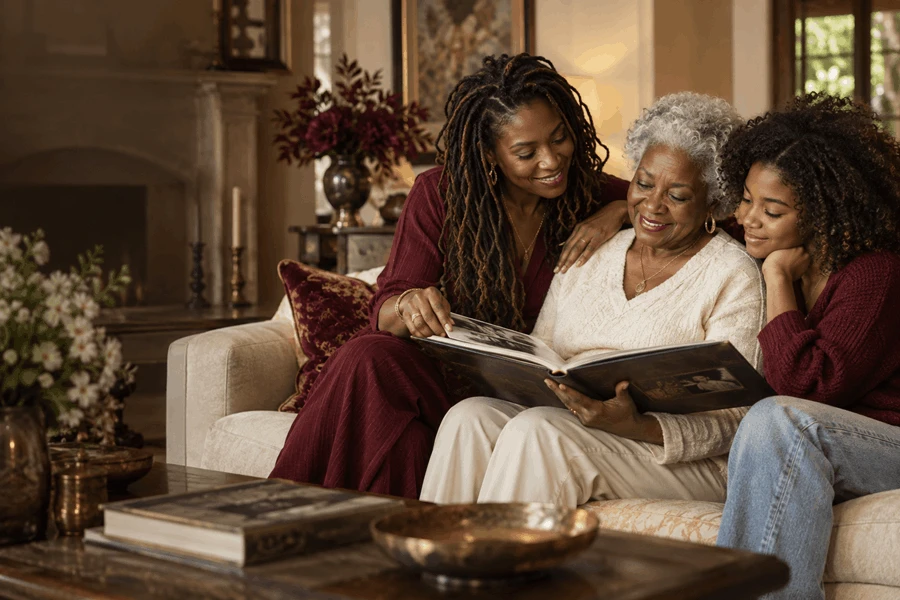
Culture lives in the things we remember, the questions we ask, and the everyday ways we make room for one another.
Somewhere in a family album, a woman is wearing a dress nobody can identify. Someone remembers the occasion but disagrees about the year. A younger relative points to the background and asks who owned that house. Then the conversation changes. What began as a photograph becomes a story about a first job, a long journey, a friendship, a decision that altered several lives.
Culture often arrives this way: quietly, inside something we thought we already understood. It is present in the particular way a name is pronounced, the song that makes someone leave her chair, the meal that tastes almost right but needs one adjustment nobody measures. It is also present in new things: a daughter’s poem, a grandmother’s late interest in painting, a family gathering held differently because the family itself has changed.
For Black women, inheritance can be abundant and complicated. There may be pride alongside unanswered questions, tenderness beside difficult memories, several languages beneath one roof. No single tradition can contain all of that. The task is not to produce a flawless account of where we come from. It is to pay enough attention that the people within the account remain people.
The lives behind the familiar titles
Mother, auntie, grandmother, cousin: these words tell us how someone is related to us. They can also hide everything she was before we arrived. The woman who always knows what time dinner should begin may once have wanted to travel somewhere she never reached. The relative who seems serious in every family discussion may have been known for making her friends laugh.
Ask about a pleasure rather than an achievement. What did she enjoy wearing? Who was her closest friend? What did she do with her first earnings? Questions like these allow a person to step outside the role the family has assigned her. They also give us a fuller understanding of the choices that shaped the life we recognize.
A woman does not have to have led a public movement or appeared in a newspaper to deserve this attention. Her ordinary life contains taste, skill, judgment, and desire. When we preserve only what she sacrificed, we risk making her generosity the entire definition of her existence.
Look again at what has survived
A photograph is more than proof that an event occurred. Consider the small decisions inside it: a carefully chosen hat, a hand resting on someone’s shoulder, a person standing just beyond the group. These details cannot tell us everything, but they can invite better questions.
In Listening to Images, scholar Tina M. Campt studies overlooked photographs of Black subjects across the diaspora, asking readers to attend to forms of expression that conventional viewing can miss. Her work offers a scholarly reminder that images deserve patient interpretation, including attention to how and why they were made. Tina M. Campt, Duke University Press, 2017 (https://www.dukeupress.edu/listening-to-images)
At home, that can mean resisting the urge to attach a confident story to a face you do not know. Write down what is certain and what remains a question. Ask an older relative while there is still someone to ask. Preserve the uncertainty too. An honest gap is more useful to the next generation than an appealing invention.
A family can hold several versions
Two sisters may remember the same house differently. One recalls its warmth; the other recalls how difficult it was to leave. One remembers a parent’s strictness as protection; another remembers feeling unheard. The existence of different memories does not automatically make one person dishonest.
Listen for perspective before trying to settle every disagreement. How old was each person? What responsibilities did she carry? What was she allowed to know at the time? These questions can explain why one event occupies such different places in the lives of those who experienced it.
Facts still matter. Dates, locations, and records can help establish what happened. Yet the emotional meaning of an event may remain different for different people. A generous family history can make space for that complexity without forcing everyone into a single approved feeling.
Keep the sweetness without polishing away the truth
There is a temptation to make the past beautiful enough that nobody has to feel uncomfortable. The family becomes unusually brave, every hardship produces a lesson, and every disagreement disappears before the photograph is captioned. The result may sound admirable, but it can become difficult to recognize.
A truthful legacy does not require public disclosure of every private wound. It does require care with what we claim. We can celebrate someone’s talent without denying that a relationship was painful. We can acknowledge an injustice without making suffering the only thing worth remembering about the people who endured it.
Sometimes the most loving sentence is an unfinished one: this is what we know; this is what we are still trying to understand. It allows younger people to inherit curiosity rather than a performance they are expected to maintain. They do not have to pretend the family was perfect in order to value it.
Make room for the culture you are creating now
It is easy to imagine culture as something belonging to elders, waiting to be handed down intact. But every generation makes decisions about how to live together. A new greeting, a yearly gathering, a shared playlist, or the way a family welcomes a newcomer can become part of its recognizable life.
Think about a practice you would like someone to remember. Perhaps nobody eats alone after a difficult appointment. Perhaps birthdays include a letter instead of an expensive gift. Perhaps the children are asked for their opinions and allowed to finish speaking. These choices can be small and still shape what home feels like.
You do not need to announce a tradition for it to take root. Repetition, affection, and a willingness to adapt often matter more than ceremony. The next generation may remember the feeling before it remembers the name you gave it.
Let difference remain visible
Black culture is not a single household enlarged to the size of the world. A woman whose family comes from Haiti, another with roots in the American South, and another raised in Ghana or Britain may recognize certain connections while bringing different histories, languages, and customs to the conversation.
Respect those differences by asking rather than assuming. Learn the name of a dish, the language of a phrase, or the particular community connected to a practice. Specificity adds richness. It allows appreciation without treating a whole continent or diaspora as interchangeable decoration.
Inside one family, differences may be just as significant. Marriage, migration, adoption, faith, and friendship can bring new experiences into the circle. Culture can become more meaningful when there is room to explain what matters, instead of requiring everyone to demonstrate the same familiarity before being welcomed.
Remember the people whose names were left out
Sometimes a family story centers the person who held a title and leaves out the person who made the gathering possible. Someone cooked, organized transport, translated, watched the children, or kept in touch when relationships became strained. Those forms of work can disappear precisely because everyone grew accustomed to relying on them.
When recalling an event, ask who helped it happen. When describing an accomplishment, remember the people who offered practical support. This is not an attempt to diminish individual achievement. It is a way to describe the network of effort more accurately.
Also ask about the women who lived outside the most celebrated family roles. The unmarried aunt, the friend treated as kin, the neighbor who taught a skill, the woman who moved away: each may hold a part of the story that the usual family outline misses.
Let younger people contribute in their own language
A teenager may care about family history but dislike formal interviews. She might prefer to photograph objects, create a short audio piece, draw a map, or ask questions while cooking. Participation becomes easier when the method leaves room for her interests rather than testing whether she can imitate an older generation.
Invite curiosity without demanding instant reverence. Explain why an object matters. Tell the amusing part of a memory as well as the moral. Allow a younger person to ask something unexpected. A question that seems simple can reveal how much context adults have forgotten to explain.
The exchange can travel in both directions. Younger relatives can share the music, art, or ideas that matter to them. Listening does not have to mean agreeing with every preference. It means recognizing that the family’s cultural life is still being made.
Choose what to carry with intention
You may love a tradition and still need to change how it is practiced. Perhaps the holiday meal is too much work for one woman. Perhaps travel costs prevent some relatives from attending. Perhaps a familiar joke makes someone feel unwelcome. Caring about continuity includes noticing who pays its price.
Ask which part matters most. Is it the exact menu, or gathering at the same table? Is it the location, or the opportunity to hear one another? Sometimes changing the format preserves the purpose more faithfully than repeating the old arrangement at any cost.
There is a particular kind of maturity in saying, with affection, that something can be different now. You can keep a recipe and share the labor. Keep a celebration and widen the invitation. Keep a story and tell it more honestly. What you pass forward can contain both gratitude and thoughtful change.
One day, somebody may open an album and stop at a picture of you. Perhaps they will know your name and the occasion. Perhaps they will wonder what you were laughing about. The legacy begins long before that moment, in the way you make people feel welcome, the attention you give their answers, and the stories you decide are worth keeping. Leave them something more than a polished portrait. Leave them a voice they can recognize, a little room for questions, and evidence that ordinary life was worth loving while it was here.
© 2026 TopBlackBeauty.com

As a passionate news reporter, I am fueled by an insatiable curiosity and an unwavering commitment to truth. With a keen eye for detail and a relentless pursuit of stories, I strive to deliver timely and accurate information that empowers and engages readers.

Comments (0)