
A New Generation of Storytellers
The next meaningful story may begin with your attention, your questions, and a place you already know. A young woman stands in front of a painting for longer than she expected. Something in the color reminds her of a room she has not visited in years. Across town, another woman records her grandmother explaining the name of a street. Someone else has started writing short scenes during her lunch break, unsure whether they belong to a novel. None of these imagined beginnings needs a grand announcement. A creative life can start quietly, through the decision to stay with something that catches your attention.
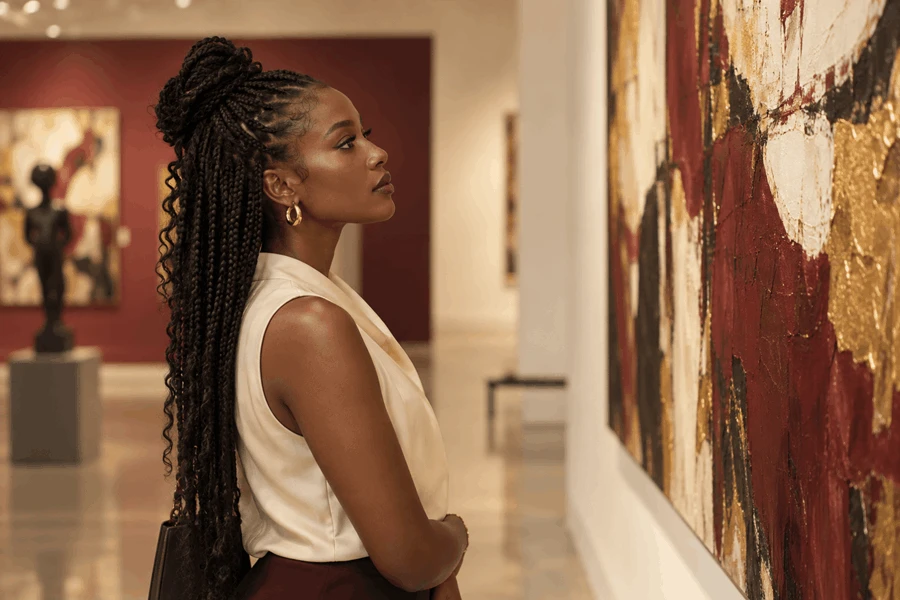
The next meaningful story may begin with your attention, your questions, and a place you already know.
A young woman stands in front of a painting for longer than she expected. Something in the color reminds her of a room she has not visited in years. Across town, another woman records her grandmother explaining the name of a street. Someone else has started writing short scenes during her lunch break, unsure whether they belong to a novel. None of these imagined beginnings needs a grand announcement. A creative life can start quietly, through the decision to stay with something that catches your attention.
For an emerging storyteller, that decision matters. It is easy to spend so much time imagining the finished work that the first small task begins to feel inadequate. You picture the exhibition, the book, the film, or the audience. Then you look at your notebook and see a few uncertain lines. The distance can feel discouraging until you remember that finished work is made through a series of particular, imperfect actions.
You do not have to speak for a generation to belong to one. You can begin with a subject small enough to know closely: a family business, a friendship, a neighborhood garden, the women who meet at a particular table, or the private experience of leaving home. A precise story often reaches further than a broad statement because it gives another person something real to enter.
Find the question underneath your interest
An appealing subject is a beginning, but a question gives the work direction. If you want to photograph a neighborhood, ask what you are trying to notice. Are you interested in how people use their front steps, how a street changes through the day, or how residents remember a place that looks different now? Each question suggests different photographs and different conversations.
A family story can benefit from the same focus. Instead of attempting to document an entire life at once, you might explore one journey, one job, or one friendship. A smaller scope allows room for texture. You can pay attention to the pauses, objects, settings, and choices that a rushed summary would leave behind.
Write your question in a sentence you can understand without explaining it for five minutes. You can revise it later. For now, it helps you decide what belongs in the project and what can wait. It also gives you a clear way to describe your idea to someone whose participation you hope to invite.
Interest should survive more than the appeal of a striking image. Ask why you want to spend time with this subject after the first excitement passes. There is no single correct answer, but an honest one can sustain the work. Affection, curiosity, uncertainty, and a desire to preserve something can all be worthwhile reasons to begin.
Choose a form that suits what you notice
Some stories depend on a voice. The rhythm of a sentence, a laugh that arrives before the words, or the way someone pronounces a familiar name may be difficult to carry in a photograph alone. Audio can preserve those qualities. Other stories depend on movement, on the relationship between a person and a room, or on a visual detail that language would take several paragraphs to describe.
A written essay gives you space to reflect, move through time, and distinguish what happened from what you now understand. A photo essay can build meaning through the order of images and carefully written captions. A short film can combine sound, setting, gesture, and sequence. None of these forms is automatically more serious than another. The useful question is what the form allows the story to do.
Begin with tools you can use reliably. A clear recording made in a quiet room may serve a small project better than unfamiliar equipment that distracts you throughout the conversation. A carefully selected group of photographs can be more effective than a large collection with no discernible relationship. Attention, preparation, and editing remain necessary at every level of equipment.
Try a modest first version before committing to an elaborate production. Write an eight-hundred-word scene, arrange six photographs, or record a short conversation with permission. This is a working experiment, not a verdict on your talent. It will teach you which parts of the idea have energy and which need another approach.
Look beyond the most obvious image
A camera can encourage us to notice what is immediately striking. Storytelling also asks for patience with what is quiet: an empty chair, a repaired hem, a hand resting on a familiar surface, or the ordinary objects someone has chosen to keep. These details need context, but they can carry feeling without demanding a dramatic event.
In Listening to Images (https://www.dukeupress.edu/listening-to-images), scholar Tina M. Campt considers overlooked photographs of Black diasporic subjects and the meanings that attentive engagement can reveal. Her work offers a demanding invitation to look beyond an image’s most obvious surface or official purpose.
For your own project, this might mean asking a person which photograph matters to her before choosing the one you find most visually attractive. It might mean learning why an object is present rather than using it as decoration. A good-looking image does not automatically tell a responsible or interesting story. The relationship between what we see and what we know needs care.
When photographing people, resist deciding in advance what their expression should mean. A serious face does not prove sorrow, and a smile does not summarize a life. Captions should identify what you can substantiate. If a person shares an interpretation of her experience, attribute it to her instead of presenting your assumption as fact.
Build trust into the work
If other people participate, explain the project plainly. Tell them what you hope to make, where it might appear, and what kind of contribution you are requesting. A private conversation, a public interview, and a promotional photograph create different expectations. People need enough information to make a meaningful decision about taking part.
Do not treat familiarity as automatic permission. A friend may enjoy being photographed but dislike having a personal account attached to the image. A relative may be comfortable sharing a story within the family and uncomfortable seeing it online. Discuss those distinctions before you rely on the material. Keep a written record of the permissions and limits you agree on.
When working with children, take particular care with privacy and obtain the appropriate guardian permissions. Consider whether identifying details are necessary at all. The fact that something is easy to publish does not answer whether it belongs in a public project. If the work raises legal or safeguarding questions, get qualified guidance rather than improvising around them.
Trust continues after the recording ends. Send the finished work or tell participants how to access it. Correct factual errors promptly. If the project changes substantially, revisit the original understanding. These practices may not appear in the final photograph or paragraph, but they shape the kind of storyteller you are becoming.
Learn to edit without losing the heart
First drafts often contain the writer’s process alongside the reader’s story. You may need several paragraphs to discover the sentence that should begin the piece. You may love a photograph because taking it was difficult, even though it does little for the sequence. Editing asks you to distinguish your attachment to making something from its contribution to the finished work.
Set the project aside briefly if you can, then return with a few concrete questions. What is the reader meant to understand here? Where does the work become vague? Which details are doing the most? What remains unsupported? These questions are more useful than asking whether the whole thing is brilliant or terrible.
Seek feedback from someone who can be specific. “I wanted to know more about this moment” offers a direction. “I lost track of who was speaking here” identifies a problem you can solve. You do not have to accept every suggestion, but listen for patterns when several readers stumble in the same place.
Keep the language that belongs to the work. Editing should improve clarity without smoothing away every distinctive rhythm or cultural detail. At the same time, do not assume a reader will understand information you have never supplied. You can welcome an audience into a particular world without explaining every part of that world as though it were an exhibit.
Let generations meet through making
A new generation of storytellers does not have to begin by leaving older people behind. Collaboration can bring different kinds of knowledge together. One person may understand recording equipment; another may know the history of a neighborhood, the relationships behind a photograph, or the significance of a name. Neither contribution needs to be treated as ornamental.
Make the exchange genuine. Ask an elder what she wants the project to preserve. Invite her to identify errors and explain what a younger collaborator may have missed. In return, share practical skills when they are welcome, such as organizing digital photographs or making a recording easy to play. Collaboration works best when both people have something to offer and something to learn.
You can also learn from peers without competing over who began first. Exchange drafts, attend one another’s small events, and share useful opportunities. Give credit when an idea, introduction, or practical contribution helped your project take shape. Creative communities become more trustworthy when generosity includes acknowledgment.
Not every relationship will become a lasting partnership. Different schedules, expectations, or working styles may make collaboration difficult. Clear agreements about deadlines, ownership, payment, and credit can prevent avoidable resentment. Friendship benefits from practical clarity when work and affection occupy the same space.
Finish something small enough to share
A completed small project teaches lessons that an endlessly expanding idea cannot. Choose a manageable endpoint: a short essay for a local publication, a private family audio collection, a modest exhibition, or a photo story with accurate captions. Decide what completion means before adding another layer of ambition.
Preserve the material behind the finished piece. Label files clearly, keep backups, and retain source notes and permissions where you can find them. Your future self should not have to reconstruct the basic facts of a project from a folder of mysterious filenames. Organization gives your creative work a better chance of remaining useful.
Then allow the work to meet its audience at an appropriate scale. A few thoughtful readers may be enough for a first project. Their responses can reveal connections you did not anticipate and questions you may want to explore next. You do not need to confuse a small beginning with a small possibility.
The next story will ask something different of you. That is part of the pleasure. With each attempt, you become more attentive to what you notice, more precise about what you know, and more responsible for what you share. Somewhere, a reader or viewer may recognize a world she has rarely seen treated with such care. Your beginning can become part of her sense of what is possible.
© 2026 TopBlackBeauty.com

As a passionate news reporter, I am fueled by an insatiable curiosity and an unwavering commitment to truth. With a keen eye for detail and a relentless pursuit of stories, I strive to deliver timely and accurate information that empowers and engages readers.

Comments (0)