
Trends Come and Go. Your Style Belongs to You.
Own your look, celebrate your journey, and decide what comes next on your own terms. An old photograph can tell you more about your style than you expect. There is the outfit itself, of course, and perhaps a detail you would not choose now. But there is also something recognizable: the way you enjoyed a strong color, the ease of a certain shape, the earrings that appeared again and again. Beneath the changing clothes, you may see a thread of preference that has quietly remained yours.
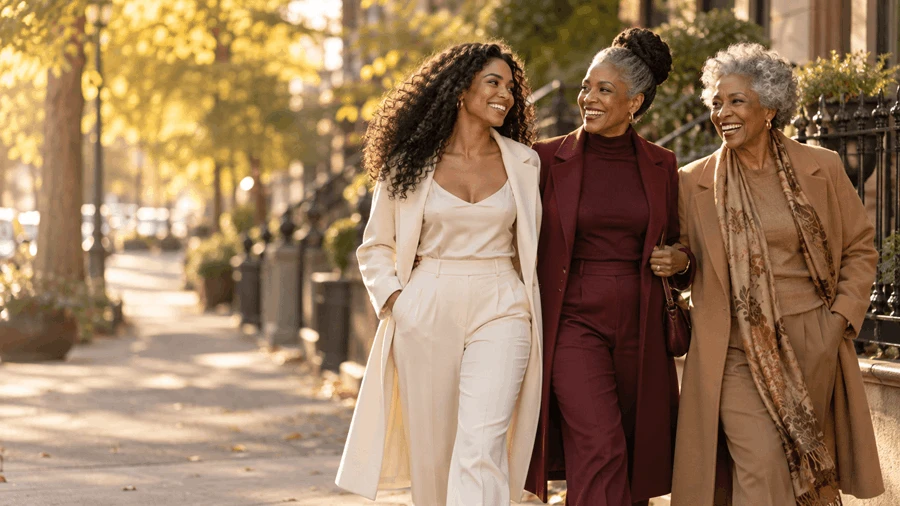
Own your look, celebrate your journey, and decide what comes next on your own terms.
An old photograph can tell you more about your style than you expect. There is the outfit itself, of course, and perhaps a detail you would not choose now. But there is also something recognizable: the way you enjoyed a strong color, the ease of a certain shape, the earrings that appeared again and again. Beneath the changing clothes, you may see a thread of preference that has quietly remained yours.
Then there are the surprises. The woman in the photograph loved something you no longer enjoy, or wore clothes chosen under circumstances you have since left behind. You do not need to be embarrassed by her. She was dressing for her own moment with the information, resources, hopes, and influences she had. Your current style can grow from that history without being required to repeat it.
Fashion offers a continuous stream of possibilities. You can enjoy that movement without allowing every new arrival to become an instruction. A trend may introduce something wonderful to your wardrobe, pass by without interest, or remind you of a piece you already own. Your role is to choose what deserves a place in your actual life.
Notice the difference between interest and urgency
A new look can be genuinely appealing. Perhaps a color feels fresh, a trouser shape offers a proportion you enjoy, or an accessory gives familiar clothes another direction. Let yourself notice the attraction. Curiosity is part of the pleasure of style, and there is no need to reject something simply because other people enjoy it too.
Urgency is a different experience. It tells you that your wardrobe has suddenly become inadequate and that you must act before the opportunity disappears. When that feeling appears, pause. Ask what specifically interests you about the item and whether it would still appeal without the surrounding excitement.
Imagine it on an ordinary day, with your own shoes, bag, weather, and activities. Would you wear it comfortably? Does it connect with clothes you already use? Are you drawn to the garment or to the life suggested by the photograph? The answers can clarify the difference between an attractive image and a useful choice.
You can also wait. A preference that survives a little time may be easier to understand. If the item is no longer available when you return, the underlying idea can still guide you toward something else. Style does not depend on capturing every opportunity at the exact moment it is presented.
Keep your history without becoming fixed in it
Clothes can connect you to places and people. You may recognize your mother's love of a crisp shirt in your own wardrobe, or remember a relative through the way you wear a scarf. These influences can remain meaningful even when your overall appearance differs from theirs. Inheritance can be selective and creative.
Historian Tanisha C. Ford's Liberated Threads (https://tanishacford.com/liberated-threads-black-women-style-and-the-global-politics-of-soul/) traces connections among Black women's style, activism, and cultural exchange across national boundaries. Her work reminds readers that fashion histories include women's choices and social circumstances, not only designers and changing products.
Your own wardrobe does not have to carry the weight of representing that whole history. It can, however, be a place where you recognize that your tastes have context. Family, music, place, work, faith, and friendship may all have contributed. Knowing those influences can make your choices feel richer without making them less personal.
You are also free to change what you inherited. Perhaps you prefer simpler clothes than the women who raised you, or more color than your younger self expected. Affection does not require identical taste. A living relationship with style includes the ability to add something new to what you have received.
Describe the qualities you want to keep
Instead of choosing a fixed style label, identify a few qualities that matter to you. You might want your clothes to feel relaxed, expressive, practical, graceful, or sharp. These words can guide decisions while leaving room for variety. Different outfits can express the same quality in different ways.
Make the words concrete. If you want ease, what features create it: soft fabric, room to move, simple fastenings, or familiar combinations? If you want drama, do you enjoy volume, contrast, color, or unusual detail? Specific answers help you recognize what you like rather than relying on a vague impression of how an outfit is supposed to feel.
Look at the pieces you wear most often for evidence. A favorite may reveal more than a carefully saved inspiration image. You may discover that you like an idea in photographs but consistently prefer something else on your own body. That is useful self-knowledge, not a lack of imagination.
Let your priorities change with circumstances. A new job, a move, caregiving, retirement, or a different level of activity can shift what you need from clothing. Your style can respond without disappearing. Often, a familiar color or detail provides continuity while the practical structure changes around it.
Try a trend at the scale that suits you
You do not have to adopt an entire look to explore one part of it. A new color can appear in a scarf before becoming a dress. A wider silhouette can begin with one pair of trousers. A decorative detail can be tested on clothes you already own. Small experiments make it easier to learn what you genuinely enjoy.
Borrowing or trying on can help when the opportunity is available and appropriate. Pay attention to how the garment feels in motion, not only how exciting it seems at first. If it requires constant adjustment or conflicts with your routine, you can admire it and leave it behind.
If a purchase makes sense, decide how you intend to wear it before bringing it home. This need not remove spontaneity. It simply gives the item a route into your wardrobe. The most interesting new piece is still more satisfying when it participates in your life rather than waiting indefinitely for the perfect setting.
You may discover that a trend becomes a lasting favorite. That is one way personal style develops: something arrives from outside your usual habits, you try it, and it remains because it works. You do not need to abandon it when attention moves elsewhere. Continued enjoyment is a valid reason to keep wearing it.
Refuse the idea that every body needs correction
Fashion advice often describes clothes as tools for hiding, minimizing, elongating, or disguising. Some people find particular visual effects useful, and you can choose them if you enjoy them. But those goals do not have to govern every outfit. Your body can be dressed for comfort, expression, and pleasure without being treated as a collection of problems.
When you read a rule, ask whether it serves your preference or introduces a dissatisfaction you did not have before. You may like a shape that emphasizes an area someone else says to conceal. You may enjoy volume without wanting to appear smaller. Personal style leaves room for those choices.
Fit remains important, but fit and correction are different questions. Clothes can allow movement, sit securely, and create a silhouette you like without implying that your body should resemble another one. Evaluate the garment's behavior rather than turning every shopping experience into a comparison with the model.
Extend the same freedom to other women. A style you would not choose can still be beautiful on someone who enjoys it. Appreciation becomes more generous when it does not depend on everyone following the same rules about age, size, color, or visibility.
Let repetition become part of authorship
The pieces you return to help make your style recognizable. A particular earring, trouser shape, jacket, or color can become familiar without becoming dull. Repetition allows you to refine small decisions and enjoy clothes through use. You do not have to replace a successful look simply because it has appeared before.
Care for the items that earn that place. Arrange a repair, follow suitable care instructions, or find a practical way to store them. If something eventually wears out, note what you valued about it before looking for a replacement. You may want the same qualities rather than an exact copy.
A wardrobe can also contain occasional pieces whose role is pleasure rather than daily usefulness. Keep them if they fit your resources and make sense to you. The goal is not to justify every garment through constant wear, but to make conscious choices about the space, care, and money your collection requires.
There is no final exam in personal style. You can have reliable habits and unfinished questions at the same time. A wardrobe can be coherent enough to serve you and open enough to surprise you. That combination may be more interesting than arriving at a fixed identity you are afraid to disturb.
Leave room for the next version of you
Imagine choosing an outfit a year from now. Some pieces may be familiar; others may be new. Your life may have shifted in ways you cannot predict. What you can carry forward is a way of deciding: notice what attracts you, test what works, respect your resources, and keep your own experience in the conversation.
You may become bolder, quieter, more practical, more playful, or simply more certain about what you do not enjoy. None of those directions needs to be announced as a transformation. Sometimes growth looks like choosing the comfortable shoe without apology or wearing a color you used to reserve for someone else.
The trend will have its moment. The photograph will be replaced by another. Your clothes will continue to meet your real mornings, your changing body, your ordinary plans, and the occasions you remember. Let them serve that life with beauty and care. The choices are yours to make, and the style that grows from them is yours to keep.
© 2026 TopBlackBeauty.com

As a passionate news reporter, I am fueled by an insatiable curiosity and an unwavering commitment to truth. With a keen eye for detail and a relentless pursuit of stories, I strive to deliver timely and accurate information that empowers and engages readers.
Comments (0)