
10 Box-Braid Rules That Can Help Save Your Hair—and Your Edges
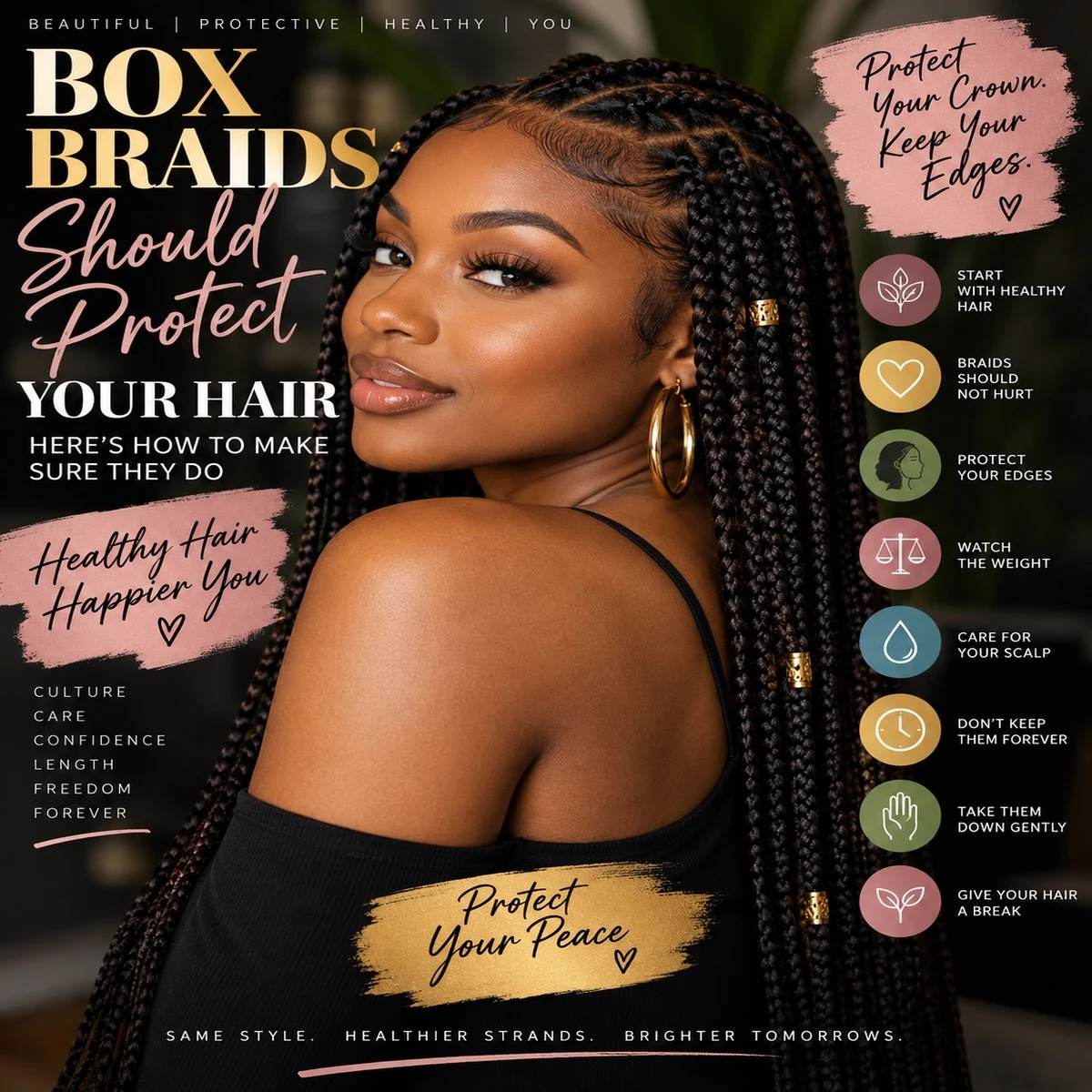
Box braids should protect your hair—not cost you your edges. Discover 10 practical, science-backed rules for preventing excessive tension, breakage, scalp irritation, and traction-related hair loss while keeping your braids beautiful
10 Box-Braid Rules That Can Help Save Your Hair—and Your Edges
Box braids are beautiful, versatile, and deeply rooted in Black beauty culture.
They can save you hours of styling, make busy mornings easier, and give your natural hair a break from daily manipulation.
But here’s the catch:
Just because we call braids a “protective style” doesn’t mean they’re automatically protecting your hair.
Braids that are too tight, too heavy, left in too long, or taken down carelessly can do exactly what you were trying to prevent: cause breakage, thinning, and damage around your edges.
A truly protective style should leave your hair in good condition when it comes down.
So before your next appointment, remember these 10 rules.
1. Healthy Braids Start Before the Appointment
Don't wait until you're sitting in your stylist's chair to think about hair health.
Start with clean, conditioned, gently detangled hair.
If your hair is already breaking, badly tangled, or stressed from another tight hairstyle, adding heavy extensions may make things worse.
And if you're experiencing unusual thinning, scalp pain, or inflammation, consider talking with a dermatologist before getting another installation.
Think of it this way: healthy braids need a healthy foundation.
2. Braids Should NOT Hurt
We've heard it for years:
“It has to be tight if you want it to last.”
No.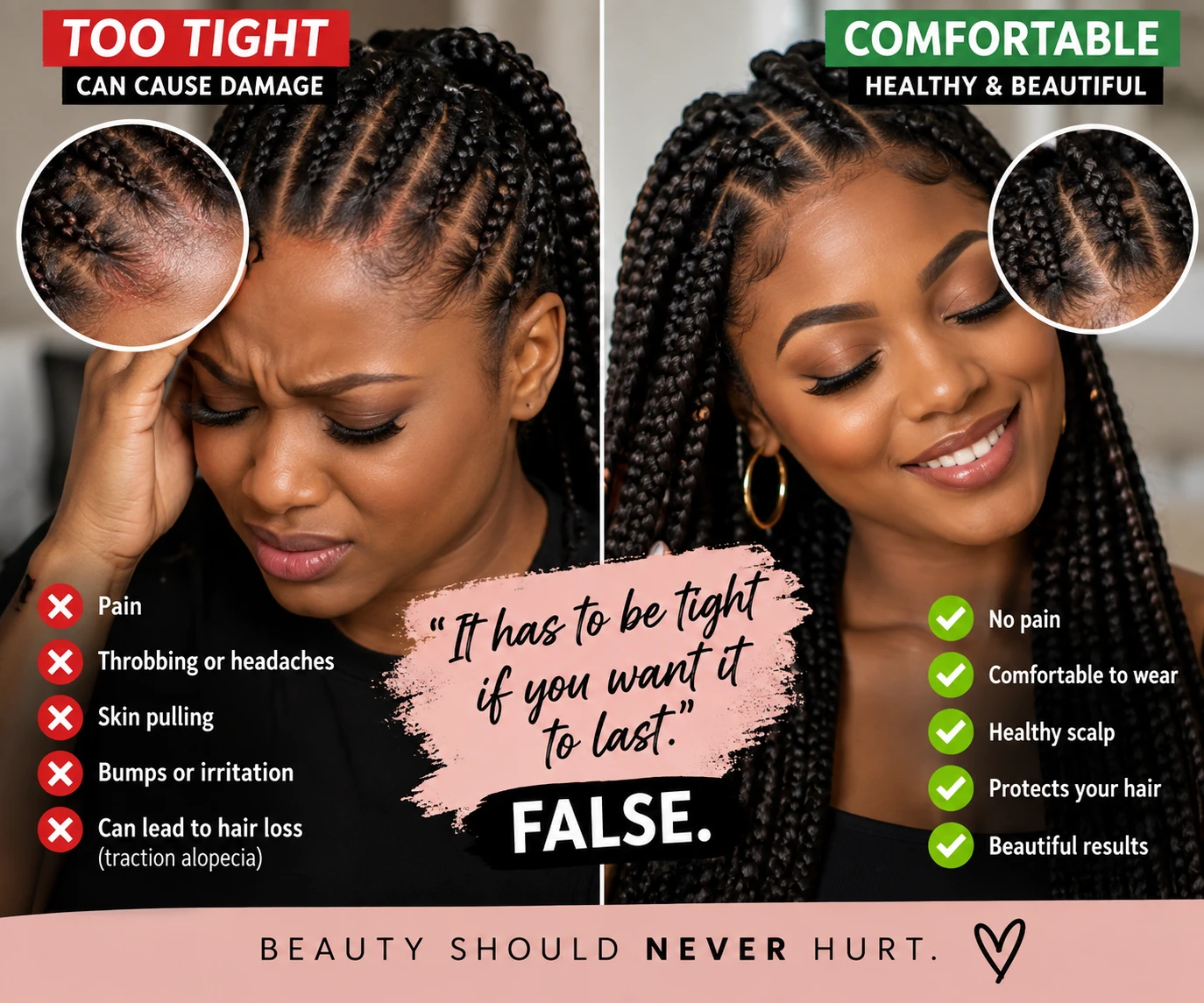
Pain isn't proof that your braider did a great job.
Throbbing, burning, stinging, bumps, headaches, or skin being visibly pulled around the braids can mean there's too much tension.
Repeated pulling can contribute to traction alopecia, a type of hair loss associated with prolonged tension on the hair follicles.
If one braid hurts while you're still in the chair, say something.
“Can you loosen that one, please?”
Your hairstyle should never require you to suffer for beauty.
3. Treat Your Edges Like Gold
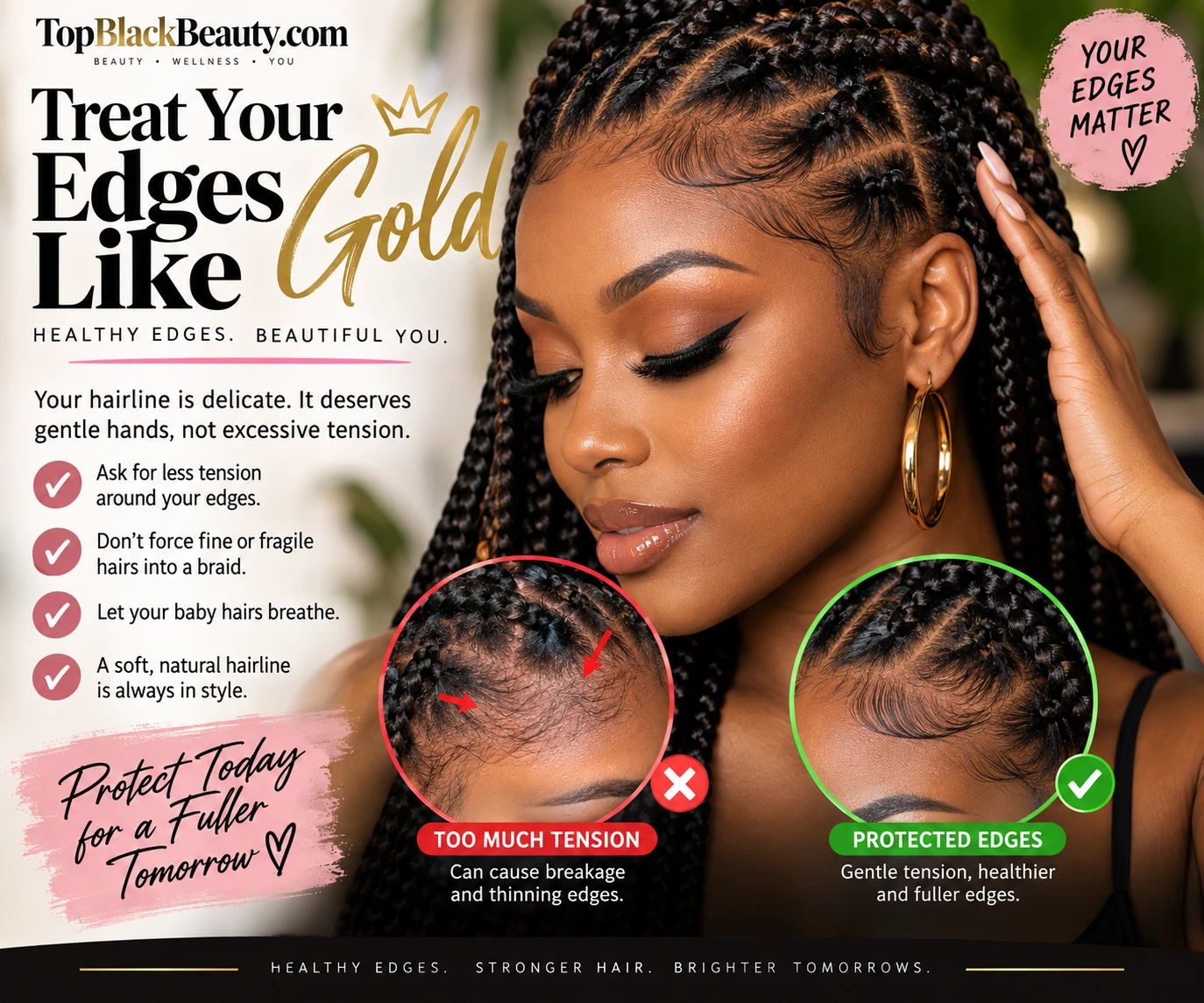
Your hairline contains some of your most delicate hairs.
Yet it's often the area we ask stylists to pull, slick, grip, and perfect the most.
Give those hairs a break.
Ask your stylist to use less tension around your temples. Very fine or fragile hairs don't always need to be forced into a braid.
And remember:
Your edges don't owe anybody a perfect Instagram picture.
A softer hairline with healthy edges beats flawless parts with thinning temples every time.
4. Beautiful Braids Can Still Be Too Heavy
Those waist-length braids?
Gorgeous.
But they're also heavier than shorter braids.
The longer and thicker your extensions become, the more weight your natural hair may have to support.
Pay attention to how your scalp feels.
If individual braids constantly tug when you turn your head, sleep, or put them up, the style may be placing too much stress on your hair.
You don't necessarily have to give up dramatic braids.
Consider lighter extensions, reasonable lengths, and braid sizes that don't put excessive weight on tiny sections of your natural hair.
Beauty should make a statement—not make your scalp suffer.
5. Your Scalp Still Needs Attention
Your hair may be tucked away, but your scalp isn't on vacation.
Sweat, natural oils, dead skin, and styling products can build up while you're wearing braids.
Clean your scalp gently as needed, and make sure your braids dry thoroughly after washing, swimming, or heavy sweating.
And don't assume every itch needs another layer of oil.
If your scalp is constantly burning, extremely itchy, red, or inflamed, pay attention.
Most importantly:
Oil cannot fix a braid that's too tight.
The Box-Braid Check
GOOD SIGNS ✓
- You can move your braids comfortably.
- You can sleep normally.
- Your hairline isn't painfully stretched.
- Your scalp feels calm.
- Your braids don't constantly tug at your roots.
WARNING SIGNS ⚠
- Throbbing or headaches
- Pain while sleeping
- Redness or bumps
- Burning or stinging
- Crusting or inflammation
- Skin visibly pulling around the braids
- Increasing tenderness around your temples
Your scalp is talking.
Listen to it.
6. Pay Close Attention During the First Few Days
The first few days can tell you whether your installation is truly comfortable.
Ask yourself:
Can I sleep without pain?
Can I move my braids comfortably?
Do my temples hurt when I touch them?
Do I see bumps, redness, crusting, or excessive pulling?
If something hurts, don't keep suffering simply because you spent $200, $300, or more on the hairstyle.
Sometimes a few braids need to be loosened.
Sometimes the perimeter needs to be redone.
And sometimes the safest decision is taking the style out.
Money already spent isn't a reason to keep hurting your scalp.
7. Watch Those High Buns and Tight Ponytails
Your braids may have been installed comfortably—and you can still create tension afterward.
Heavy braids piled into a tight high bun can pull on your hairline.
The same goes for tight ponytails.
Give your scalp variety.
Wear your braids down sometimes. Try loose half-up styles. Use gentle accessories and avoid repeatedly pulling everything tightly in the same direction.
If your scalp starts hurting after you put your braids up, that's your cue to loosen them.
Protective styling should reduce stress on your hair, not move the stress somewhere else.
8. Don't Keep Braids Forever
We understand.
Your braids still look good.
You paid good money for them.
And taking them down means spending hours on your hair again.
But braids aren't meant to stay forever.
The American Academy of Dermatology has advised limiting how long braids or locs are worn as part of preventing traction-related hair loss, with roughly six to eight weeks commonly referenced in its guidance.
As your natural hair grows, shed hair, product buildup, and tangles can collect around the roots.
Plan your takedown instead of waiting until your hair becomes extremely tangled.
Know when it's time to say goodbye—even to a style you love.
9. Takedown Day Is Hair-Care Day
You protected your hair for weeks.
Don't destroy your progress because you're impatient during the last two hours.
Take your time.
Cut extensions well below where you believe your natural hair ends. Unravel each braid gently. Separate accumulated shed hair before aggressively combing through your strands.
After weeks in braids, seeing shed hair during takedown can be normal.
But pay attention to unusual changes.
Are your temples noticeably thinner?
Are you seeing lots of broken pieces?
Does one area suddenly look sparse?
Is your scalp still painful or inflamed?
Those signs deserve attention.
How you remove your braids matters just as much as how you install them.
10. Give Your Hair Some Breathing Room
Friday: take braids down.
Saturday: install another set.
Sunday: edges are tight again.
Repeating that cycle without giving stressed areas a break can keep putting pressure on the same follicles.
After taking down your braids, look at your hair.
Check your edges.
Check your scalp.
Notice whether anything feels sore or looks thinner.
When your hair needs a break, consider lower-tension styles before adding another heavy installation.
Sometimes the best protective style is simply giving your hair a chance to breathe.
Teach Our Girls That Beauty Shouldn't Hurt
For many of us, braids are part of Black girlhood.
The beads.
The barrettes.
The beautiful parts.
Sitting between someone's knees while your hair is transformed.
Those memories can stay with us forever.
But there's one tradition we don't need to pass down:
The belief that beauty has to hurt.
If a little girl says her braids hurt, listen.
Children don't need extremely heavy extensions or painfully tight hairlines to look beautiful.
Teach girls that they can tell a stylist:
“That hurts.”
“Please loosen it.”
“I don't want my hair that tight.”
That's more than a hair lesson.
That's a lesson in speaking up for themselves.
The Bottom Line
Box braids aren't the problem.
Too much tension, too much weight, repeated pulling, poor scalp care, and rough removal are the problems.
Wear your braids.
Make them long.
Add curls.
Add beads.
Play with color.
Make them bold.
Make them completely yours.
Just remember what protective is supposed to mean.
Protect your time without sacrificing your edges.
Protect your strands without punishing your scalp.
And when those beautiful braids finally come down, your natural hair should still feel like something you've been caring for all along.
Editorial Sources
American Academy of Dermatology Association — Hairstyles That Pull Can Lead to Hair Loss.
American Academy of Dermatology Association — Black Hair: Tips for Everyday Care.
Haskin, A. & Aguh, C. — All Hairstyles Are Not Created Equal: Black Hairstyling Practices and Traction Alopecia. Journal of the American Academy of Dermatology.
Johns Hopkins Medicine — Hair Loss in Black Women: Tips from an Expert.
Publication Disclaimer
This article provides general educational information and is not a substitute for individualized medical advice, diagnosis, or treatment. If you experience persistent scalp pain, inflammation, progressive thinning, or other concerning hair or scalp changes, consult a qualified healthcare professional.
© 2026 TopBlackBeauty.com. All Rights Reserved.
Frequently Asked Questions

As a passionate news reporter, I am fueled by an insatiable curiosity and an unwavering commitment to truth. With a keen eye for detail and a relentless pursuit of stories, I strive to deliver timely and accurate information that empowers and engages readers.


Comments (0)