
Wear What Makes You Feel Like You
Build a personal style that celebrates who you are, wherever life takes you. There is a particular pleasure in putting on an outfit and no longer thinking about it. The waistband sits comfortably. The color makes you linger at the mirror. Your earrings move when you turn your head, and something about the whole arrangement feels familiar in the best way. You can get on with the day because your clothes have stopped asking you to become someone else.

Build a personal style that celebrates who you are, wherever life takes you.
There is a particular pleasure in putting on an outfit and no longer thinking about it. The waistband sits comfortably. The color makes you linger at the mirror. Your earrings move when you turn your head, and something about the whole arrangement feels familiar in the best way. You can get on with the day because your clothes have stopped asking you to become someone else.
That feeling is worth paying attention to. It may arrive in an elegant suit, a loose dress, a favorite pair of jeans, or the shirt you have worn so often that the fabric knows your shoulders. Personal style does not have to be elaborate to be recognizable. It grows through the small decisions that make an outfit feel like a place you can inhabit.
For a Black woman, those decisions may sit beside other people's expectations: how polished to appear, how much attention to attract, which parts of your appearance will be read as professional, respectable, fashionable, or excessive. You may know the tiring work of anticipating those judgments before anyone has said a word. Your own preferences deserve space in the conversation, too.
Begin with the woman getting dressed
Before collecting another set of fashion rules, look at the life your wardrobe needs to serve. How much do you walk? Where do you spend your time? What weather do you actually dress for? Which clothes let you work, sit, travel, pray, dance, or rest without repeatedly adjusting yourself? These questions give personal style a foundation in your real days.
Then consider pleasure. Perhaps you enjoy crisp collars, dramatic sleeves, warm colors, or jewelry with a little history. Perhaps you prefer soft fabrics and almost no ornament. Your preferences do not need a fashionable name before you can trust them. Nor do they need to remain identical in every setting. You can enjoy a quiet weekday wardrobe and still love dressing extravagantly for a celebration.
Try describing three outfits you already love. Write down the details rather than judging whether they are impressive enough. You might notice a repeated neckline, a particular balance of loose and fitted pieces, or a fondness for an unexpected shoe. Those observations offer more useful direction than a shopping list written for an imaginary woman with a different body and calendar.
Style has a history beyond the mirror
Historian Tanisha C. Ford's Liberated Threads: Black Women, Style, and the Global Politics of Soul (https://tanishacford.com/liberated-threads-black-women-style-and-the-global-politics-of-soul/) examines the relationship between Black women's style and activism across several locations, including the United States, Britain, and South Africa. Her work takes clothing, jewelry, and hair seriously as parts of cultural and political expression.
That history can enrich the way we look at dress without requiring every outfit to deliver a public statement. You may wear a headwrap because it connects you to someone you love, because you enjoy the shape, or because it suits the day. Meaning can be layered, private, or simply pleasurable. You do not owe an explanation to everyone who notices you.
There is also no single authentic way for a Black woman to dress. Our tastes are shaped by different families, places, religions, professions, generations, and imaginations. One woman's love of minimalism does not diminish another woman's devotion to color. The variety is part of the beauty. Personal style becomes more generous when it leaves room for that difference.
Borrow an idea, then make it usable
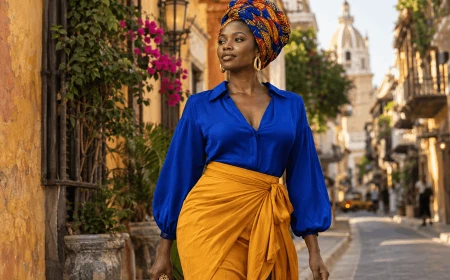
An inspiring photograph can be a starting point rather than an instruction to purchase everything in it. Look for the element that holds your attention. Is it the contrast between a fluid blouse and structured trousers? The warm brown against blue? The ease of a dress with flat shoes? Once you identify the idea, try it with something you own.
Suppose you admire a cream suit but rarely need one. You could explore the same tonal effect with an ivory shirt and light trousers. If an elaborate necklace feels too much for your daily life, a smaller pendant may offer the glint you wanted. The goal is to translate the appeal into your circumstances, not reproduce a stranger's photograph exactly.
This approach also makes experimentation less expensive. Change one part of a familiar outfit and notice what happens. Roll the sleeves differently, try another shoe, move a belt, or let a patterned scarf appear at the neckline. Small changes teach you what you enjoy without turning every moment of uncertainty into a shopping trip.
Give an unfamiliar combination time to become familiar. Sometimes a look feels wrong because it is uncomfortable or impractical; sometimes it merely differs from your routine. Wear it briefly at home, move around, and ask which of those experiences you are having. You can decide against it without calling the experiment a failure.
Dress the body that is here
Clothes can carry difficult promises. You may be keeping a dress for the version of yourself you hope to become, or avoiding a color until you feel more confident. Meanwhile, the woman who has appointments, errands, and invitations this week is left with fewer comfortable choices. She deserves clothes that work now.
A label is information about a garment, not a verdict about you. Fit can vary across designs and brands, so look at what the clothes do on your body. Can you breathe easily, sit without strain, and move your arms? Does the fabric fall in a way you enjoy? A garment that fails those tests is giving you information about its suitability.
If an alteration might help, ask a skilled tailor what is realistic before spending more. A hem or a modest adjustment may be straightforward; changing the entire structure can be complicated. You do not have to rescue every almost-right purchase. Sometimes the kinder decision is to choose a different cut and stop negotiating with the one that keeps disappointing you.
Your comfort preferences can change over time. A shoe you once loved may no longer suit your walking, and a close neckline may begin to feel restrictive. Responding to those changes does not mean giving up on style. It means becoming more precise about the conditions in which you can enjoy it.
Separate admiration from obligation
You can think someone looks wonderful and still know that her outfit is not for you. Perhaps you love a dramatic heel in a photograph but want shoes that carry you comfortably through a long day. Perhaps you admire a highly edited neutral wardrobe while feeling happiest in print. Appreciation does not require imitation.
The same distinction helps with gifts and inherited clothes. A piece can be meaningful without becoming a regular part of your wardrobe. You might preserve it carefully, wear it on particular occasions, or pass it to someone who will use it with affection. Gratitude does not have to take the form of wearing something that makes you feel unlike yourself.
Notice whose opinion you consult most often. A thoughtful friend can help you see possibilities; someone who dismisses every choice outside her own taste may leave you doubting preferences that were clear a moment before. Ask for useful feedback about fit or combinations while remembering that you will be the person living in the outfit.
There is room for modesty, glamour, softness, sharpness, and play in this process. You may value several at once. The task is to find combinations that feel honest to your tastes and appropriate to your own needs, rather than proving that you fit a category someone else has chosen.
Let repetition become a pleasure
A recognizable wardrobe often includes repetition. You might return to wide trousers, a certain kind of earring, or dresses with room to move. Those choices can become a personal vocabulary. Familiarity frees you to notice smaller variations in texture, proportion, and color instead of starting from nothing every morning.
Repeat complete outfits when they serve you well. A look does not lose its usefulness because someone has seen it before. You can also record combinations in a private photo folder, especially the ones that work on difficult mornings. An ordinary mirror picture can be a practical reminder when your memory insists you have nothing to wear.
Keep a little space for surprise. A consistent style need not become a uniform you are afraid to change. You may discover a new color through a borrowed scarf or realize that a different trouser shape suits your current life. Curiosity keeps the relationship with your wardrobe alive without requiring constant replacement.
Make the last question your own
Before leaving, try asking something gentler than whether you look perfect. Can I move comfortably? Do I like something about this? Does the outfit suit the day I am about to have? Those questions offer an exit from endless correction. At some point, getting dressed should end and living should begin.
If the answer is only partly yes, identify the practical problem. Change the shoe that pinches or the layer that feels too warm. Avoid turning one awkward detail into a criticism of your whole body. An outfit is an arrangement of objects. It can be adjusted without making your worth part of the fitting-room discussion.
You may also have days when clothing receives very little attention. That is allowed. Interest in style can coexist with fatigue, distraction, and other priorities. A comfortable, familiar outfit can carry you through those days without needing to demonstrate creativity. You do not have to earn the right to care less for an afternoon.
And on the days when you do want to linger, let yourself enjoy it. Put on the earrings, choose the color, smooth the fabric, and notice the woman looking back. She does not need to become an ideal version before she can enjoy being seen. Her life is happening now, and there is room in it for the uncomplicated pleasure of feeling like herself.
© 2026 TopBlackBeauty.com

As a passionate news reporter, I am fueled by an insatiable curiosity and an unwavering commitment to truth. With a keen eye for detail and a relentless pursuit of stories, I strive to deliver timely and accurate information that empowers and engages readers.

Comments (0)