
The Story America Rarely Tells: How Haitians Helped Shape the United States
Celebrate heritage, culture, identity, and Black excellence through inspiring stories, achievements, traditions, and the people shaping communities and creating lasting impact.
The Story America Rarely Tells: How Haitians Helped Shape the United States
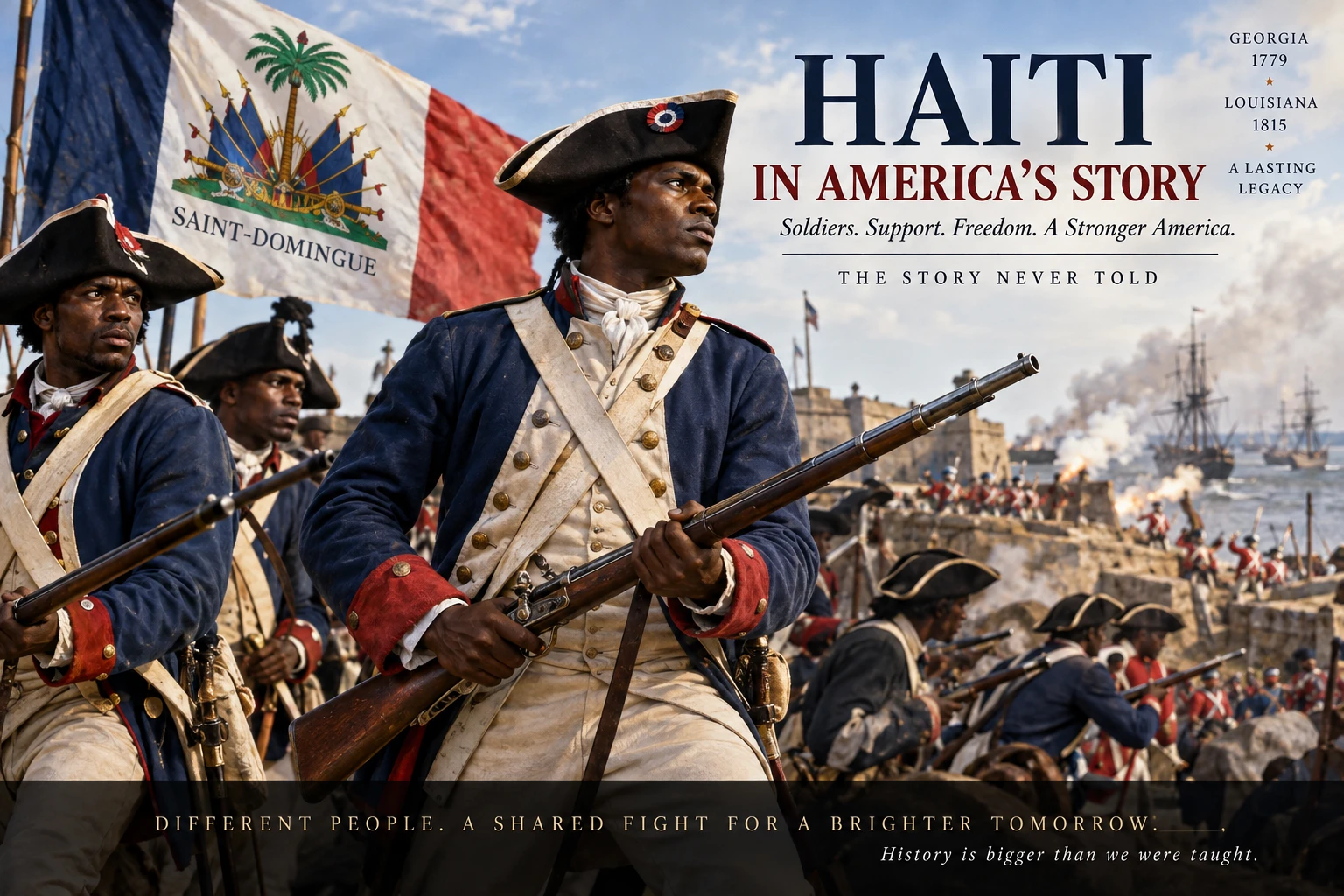
From the battlefields of Savannah to the shores of Louisiana, the people of Saint-Domingue—today’s Haiti—appear in some of the most consequential chapters of early American history. Their contribution deserves to be remembered.
When Americans tell the story of their nation's birth, familiar names rise immediately: George Washington, Thomas Jefferson, Benjamin Franklin, the Continental Army, France, and the thirteen colonies.
But another place belongs in that conversation.
Haiti.
Long before Haiti declared its own independence in 1804, the Caribbean colony then called Saint-Domingue was connected to America's struggle against Britain. Men from Saint-Domingue crossed the sea and served in the campaign at Savannah, Georgia. The colony was part of the Caribbean world through which French assistance reached the American cause. Decades later, people with connections to the Haitian Revolution would help defend Louisiana during the War of 1812.
And perhaps most dramatically, Haiti's successful revolution helped destroy Napoleon Bonaparte's dream of a French empire in North America—one of the developments that led France to sell the enormous Louisiana Territory to the United States.
This is not a story about claiming that Haiti created America by itself.
It is something more meaningful: recognizing that American history has always been connected to Black and Caribbean history, even when those connections receive far less attention.
1779: Men From Saint-Domingue Arrive in Georgia
The American Revolution was still raging in 1779.
Savannah, Georgia, had fallen under British control. French and American forces planned an attempt to recapture the strategically important city.
Among the forces arriving from the Caribbean was an extraordinary military unit:
The Chasseurs-Volontaires de Saint-Domingue.
They were free men of color recruited in Saint-Domingue, the French colony that would later become Haiti.
According to the City of Savannah's Municipal Archives, approximately 545 Chasseurs joined the 1779 expedition. The city describes them as the largest unit of men of African descent to fight in the American Revolution.
Think about what that means.
More than two decades before Haiti became an independent nation, hundreds of men from the land that would become Haiti crossed the Caribbean and entered an American Revolutionary battlefield.
They were not standing on the sidelines of history.
They were inside it.
The Siege of Savannah
The campaign culminated in the Siege of Savannah.
French and American forces attempted to drive the British from the city. On October 9, 1779, the allies launched a major assault against British defenses.
It was bloody.
It failed.
But the men of Saint-Domingue were there.
The Savannah Municipal Archives notes that historical accounts differ concerning their precise role during the final assault, an important qualification when telling the story responsibly. What is established is that the Chasseurs participated in the campaign and fought in support of the American cause.
Their presence alone tells us something remarkable about the international nature of America's Revolution.
The struggle that Americans often imagine occurring only in places such as Boston, Philadelphia, Virginia and Yorktown reached across oceans and islands.
Caribbean people were part of it.
Black men were part of it.
And men from Saint-Domingue were part of it.
Today, Savannah maintains a historical connection with this story, and Haiti presented the city with a painting depicting the troops in 1976.
Their service should not be exaggerated.
But neither should it be forgotten.
Saint-Domingue Was Also Part of America's Lifeline
Soldiers were only one part of the Caribbean connection.
At the beginning of the American Revolution, the rebellious colonies desperately needed weapons, gunpowder, clothing, money and international support.
France eventually became America's crucial European ally.
Before France openly entered the war in 1778, however, French assistance had already begun moving secretly toward the American rebels.
Saint-Domingue and Martinique became important Caribbean channels in that effort. Historical accounts describe French weapons, supplies and financial assistance being transported through Caribbean commercial networks to support the Americans.
This distinction matters.
It would be misleading to say that the independent Republic of Haiti loaned George Washington's government money—Haiti did not yet exist as an independent republic during the American Revolution.
The country declared independence in 1804.
The historically defensible story is more fascinating.
Saint-Domingue—the territory and society from which Haiti would emerge—was economically and strategically important to France, and it formed part of the Caribbean system supporting France's intervention in America's war.
The wealth involved also came at a horrifying human cost.
Saint-Domingue had become enormously profitable through plantations producing sugar and coffee, but that wealth rested upon the brutal exploitation and enslavement of Africans. The U.S. State Department's historical account describes Saint-Domingue by the 1760s as the most profitable colony in the Americas.
We should therefore never celebrate colonial wealth without remembering the people whose forced labor produced it.
Those enslaved people would eventually transform world history themselves.
Then Haiti Fought for Its Own Freedom
Beginning in 1791, enslaved people in Saint-Domingue launched what became the Haitian Revolution.
It would become one of history's most consequential revolutions.
After years of warfare involving formerly enslaved people, free people of color, French forces, British forces, Spanish forces and competing political factions, the revolution ultimately defeated Napoleon's attempt to restore French authority and slavery.
On January 1, 1804, Haiti declared independence.
The revolution created the second independent country in the Americas after the United States and established a nation born from the destruction of slavery.
But Haiti's victory also transformed the future of the United States.
The Haitian Revolution and the Louisiana Purchase
This is one of the most extraordinary connections.
Napoleon had enormous ambitions in the Americas.
Saint-Domingue was supposed to be central to those ambitions.
But French forces suffered devastating losses amid warfare and disease while attempting to regain control of the colony.
The French project collapsed.
The Library of Congress explains that the rebellion in Saint-Domingue played a critical role in the chain of events leading to the Louisiana Purchase. After France suffered heavy casualties and lost Saint-Domingue, Napoleon abandoned his plans for a renewed French empire in the New World and decided to sell Louisiana.
Then came one of the largest territorial transactions in American history.
In 1803, the United States purchased the Louisiana Territory from France for approximately $15 million.
The acquisition roughly doubled the size of the United States.
The United States did not purchase Louisiana from Haiti.
Haiti did not finance the purchase.
But the Haitian Revolution helped create the geopolitical circumstances that made Napoleon willing to sell.
That distinction makes the story more credible—not less powerful.
A revolution fought by Black people in the Caribbean changed the map of North America.
Louisiana: Another Haitian Connection
The story continued.
The Haitian Revolution displaced enormous numbers of people throughout the Caribbean and Atlantic world. Many eventually settled in Louisiana, profoundly influencing New Orleans and the surrounding region.
Then the United States again faced Britain during the War of 1812.
In late 1814 and early 1815, British forces threatened New Orleans.
General Andrew Jackson assembled an unusually diverse defensive force.
Louisiana's own historical materials record an important detail: free men of color, including recent immigrants from the Haitian Revolution, formed part of the forces defending Louisiana.
They joined Creoles, militia units, American regulars, volunteers from Tennessee and Kentucky, Native American allies, privateers and others.
On January 8, 1815, Jackson's forces decisively defeated the British at the Battle of New Orleans.
Once again, people connected to Haiti's history appeared in an important chapter of America's survival and expansion.
From Savannah to Louisiana
Put these events together.
1779 — Georgia:
Hundreds of free men of color from Saint-Domingue participated in the Savannah campaign during the American Revolution.
American Revolution:
Saint-Domingue was part of the Caribbean network through which crucial French support flowed toward the American cause.
1791–1804 — Haitian Revolution:
Enslaved and free people in Saint-Domingue fought through a revolutionary struggle that ultimately created independent Haiti.
1803 — Louisiana Purchase:
France's defeat in Saint-Domingue helped destroy Napoleon's American imperial ambitions and contributed directly to his decision to sell Louisiana to the United States.
1814–1815 — Louisiana:
Free men of color, including immigrants connected to the Haitian Revolution, were among those defending New Orleans against Britain.
These events occurred in different periods and under very different political circumstances.
They should not be collapsed into a single legend.
But together they reveal something extraordinary:
Haiti and the United States have been connected since America's earliest generations.
The Complicated Truth
There is also an uncomfortable side to this history.
Haitians and Americans fought in overlapping struggles for liberty, but the two nations did not receive equal treatment.
The United States declared independence in 1776.
Haiti declared independence in 1804.
Yet the United States did not formally recognize Haiti's independence until 1862—nearly six decades later. American leaders' fears surrounding slavery and the example of a successful Black revolution profoundly shaped U.S. policy toward the new Haitian republic.
That contradiction deserves attention.
Men from Saint-Domingue had participated in America's Revolutionary struggle in Georgia.
The Haitian Revolution helped reshape the geopolitical circumstances that enabled America's enormous territorial expansion.
People displaced by that revolution became part of Louisiana society, and men from that world later participated in the defense of New Orleans.
Yet independent Haiti waited generation after generation for diplomatic recognition from the United States.
History is rarely simple.
The Story Deserves to Be Told
The purpose of recovering this history is not to diminish anyone else's contribution to the United States.
History does not become smaller when another people's contribution is acknowledged.
It becomes more complete.
When a Haitian-American child learns about the American Revolution, that child should be able to discover Savannah.
When Americans study the Louisiana Purchase, they should understand what was happening simultaneously in Saint-Domingue.
When they study New Orleans, they should encounter the Caribbean and Haitian influences that helped shape the city.
And when the world studies Haiti, the country's history should not begin and end with poverty, earthquakes, political instability or today's headlines.
There is another Haiti.
The Haiti connected to revolution.
The Haiti whose ancestors confronted one of the most powerful armies in the world.
The Haiti whose struggle changed Napoleon's calculations.
The Haiti whose history intersects with the expansion and defense of the United States.
And the Haiti whose sons stood on the soil of Savannah, Georgia, in 1779, during America's fight for independence.
More than two centuries later, their footsteps remain part of the American story.
Perhaps the most powerful way to remember them is not to embellish what they did.
It is simply to tell what happened.
Because the documented history is powerful enough.
Before Haiti was even called Haiti, its people were already present in the story of America.
Historical note: During the American Revolution, modern Haiti was the French colony of Saint-Domingue. Therefore, references to “Haitians” in 1779 are commonly used retrospectively to describe people from the territory that became Haiti in 1804. This article distinguishes between colonial Saint-Domingue and the independent Republic of Haiti where historically necessary.
© 2026 TopBlackBeauty.com. All Rights Reserved.

As a passionate news reporter, I am fueled by an insatiable curiosity and an unwavering commitment to truth. With a keen eye for detail and a relentless pursuit of stories, I strive to deliver timely and accurate information that empowers and engages readers.


Comments (0)