
11 Natural-Hair Habits Worth Rethinking
Small, thoughtful changes can make hair care feel less punishing and more personal. Most hair habits begin with a reason. Someone taught you a method. A product worked once. A style helped you get through a busy season. You repeated what you knew, and eventually it became the way things were done.
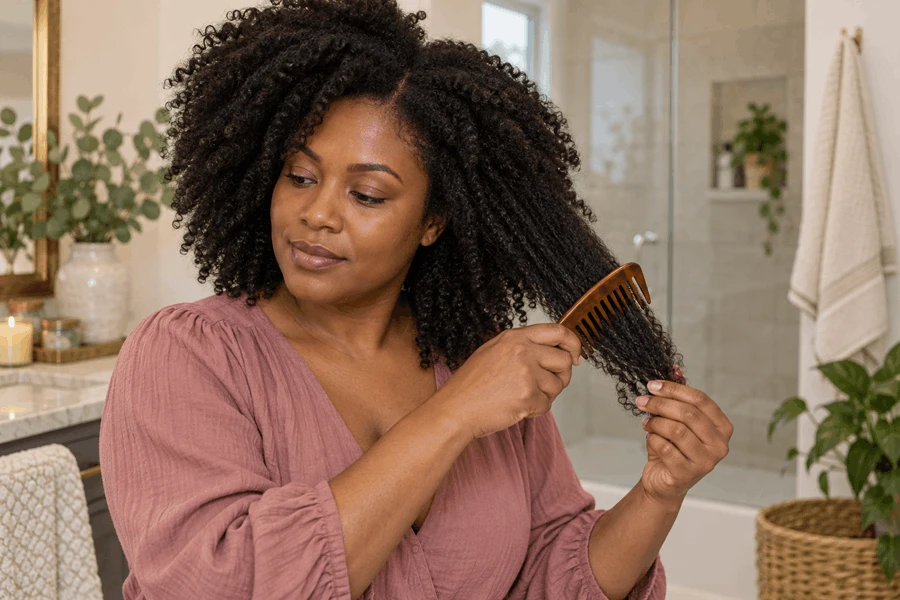
Small, thoughtful changes can make hair care feel less punishing and more personal.
Most hair habits begin with a reason. Someone taught you a method. A product worked once. A style helped you get through a busy season. You repeated what you knew, and eventually it became the way things were done.
Rethinking a habit does not mean that you were foolish or that the women who taught you were wrong about everything. Knowledge changes. Your hair changes. Your available time and preferences change too. You can keep the affection attached to a memory while choosing a different method today.
Consider these eleven habits as invitations to notice what is happening in your own routine. You do not need to overhaul everything this weekend. One useful adjustment, made with understanding, can teach you more than another dramatic restart.
1. Calling your hair difficult before you have described it
Words can become instructions. When you decide your hair is stubborn, it becomes tempting to respond with more force, more products, or less patience. Try describing the actual challenge instead: this section tangles, this finish takes too long, this product feels unpleasant.
A specific description points toward a question you can answer. It also leaves room to recognize what you like. Your hair can require a different technique without being an adversary. Start by changing the sentence you use when you pick up the comb.
If you care for a child's hair, let the language stay respectful there too. She can learn that a tangle needs attention without learning that her natural texture is a problem she brings into the room.
2. Borrowing an entire routine from a photograph
A photograph gives you a result, often without the full context. You may not know the person's haircut, products, preparation, or how long the style took. Trying to reproduce all of it can leave you disappointed for reasons that have little to do with effort.
Borrow a feature you like: the outline, the softness, or the way the hair is arranged. Then ask how that idea could work with your own circumstances. A stylist can help translate inspiration into something practical.
Your reference folder should open possibilities. If it has become a collection of evidence that your own hair is inadequate, spend a little time looking at a wider range of textures and finishes.
3. Treating every new product as a fresh beginning
Before buying, name the gap. Do you need a cleanser, a product for hold, or help understanding the application of something you already own? Without a clear purpose, shopping can become a substitute for troubleshooting.
In an academic review of hair cosmetics, Gavazzoni Dias emphasizes the importance of the whole formulation and how ingredients interact. A fashionable ingredient alone does not explain a product's performance. Hair Cosmetics: An Overview, 2015 (https://pmc.ncbi.nlm.nih.gov/articles/PMC4387693/)
Make a small list of what is open, what you tolerate, and what each item does. You may discover that the next useful purchase is no purchase at all, but a clearer method for using what is already there.
4. Rushing the part that always requires patience
If detangling is consistently the hardest step, planning it for the last minutes before an outing sets you up for frustration. Look at the conditions around the task. Is the lighting good? Are your tools nearby? Are you working in sections you can manage?
The AAD advises gentle detangling and avoiding pulling and tugging. For textured hair, its guidance includes working while the hair is damp and using a wide-tooth comb. AAD: Hair-Care Habits That Can Cause Damage (https://www.aad.org/public/everyday-care/hair-scalp-care/hair/habits-that-damage-hair)
Build the practical setup around that gentleness. If a method is uncomfortable or difficult for you, ask for a demonstration or consider help. Speed is a poor measure of care when it comes at the expense of comfort.
5. Assuming that a beautiful style must feel tight
A style can look polished without discomfort becoming part of the price. Tell your stylist about tenderness or pulling while there is still an opportunity to adjust the work. A quiet client is not necessarily a comfortable client.
Repeated traction can contribute to hair loss, and painful styles should not be endured while waiting for them to loosen. AAD: Hairstyles That Pull (https://www.aad.org/public/diseases/hair-loss/causes/hairstyles)
Practice a simple sentence before the appointment: “That feels too tight; please loosen this section.” You do not need to become confrontational. You need to give clear information about your own body. A professional relationship should have room for it.
6. Adding steps without asking what they do
A routine can grow almost unnoticed. A treatment joins a rinse, which joins another layer, which requires another purchase. Eventually you dread a process you cannot explain.
Write the sequence down and give each step a purpose. Keep the useful ones. Separate occasional pleasures from necessary care. If you enjoy a longer ritual, that is a valid preference; just avoid believing you have failed whenever you choose the shorter version.
For products with specific instructions, follow those instructions rather than inventing longer application times. Questions about a treatment belong with a qualified professional or the manufacturer. More elaborate does not always mean more appropriate.
7. Measuring progress only by length
Length can be a meaningful goal, but it is not the only experience worth noticing. Perhaps you understand your routine better, spend less time struggling, or have found a style you enjoy wearing.
Keep any comparisons consistent enough to be useful, and avoid daily inspection that leaves you discouraged. A different angle, hairstyle, or amount of stretching can make casual photographs difficult to compare.
Ask yourself what you wanted longer hair to give you. More styling options? A particular silhouette? A sense of accomplishment? Some of those desires may have satisfying answers available now, at the length you already have.
8. Making salon appointments without a conversation
Before booking, ask what the service includes, how to arrive, how long it may take, and what maintenance is expected afterward. Share relevant concerns rather than assuming the stylist can see every part of your hair history.
Bring photographs, but explain what you like about them. Ask what adjustments would make the idea suitable for your hair. A clear consultation can prevent a mismatch between what you imagined and what the service can reasonably provide.
Budget for the whole experience, including follow-up care and removal where relevant. A style that fits the appointment budget but not your weekly life may not be the best choice this time.
9. Treating scalp symptoms as a shopping problem
It is easy to respond to itching or thinning by adding an oil, another serum, or an enthusiastic recommendation from a friend. Sometimes the more useful next step is an assessment.
Persistent symptoms and changing areas of hair loss deserve a qualified explanation. One example is CCCA, a scarring condition that can begin with changes at the crown; it requires medical attention rather than assumptions about styling. AAD: CCCA Signs and Symptoms (https://www.aad.org/public/diseases/hair-loss/types/ccca/symptoms)
Keep a simple timeline and note products or services used around the time a concern began. Bring that information to the appointment. Curiosity is helpful; self-diagnosis from a photograph is much less reliable.
10. Turning a setback into a character judgment
A style fails. You used more product than you intended. An appointment did not go as expected. These are experiences to understand, not proof that you are incapable of caring for yourself.
Identify what happened as specifically as possible. What could you change next time? What requires professional help? What was simply a preference you discovered you did not share with the person who recommended it?
You can be disappointed without speaking cruelly to yourself. If your hair has become a constant source of distress, consider who could offer informed and compassionate support. You deserve more than another round of criticism from the mirror.
11. Forgetting that your routine exists to serve your life
Hair care is allowed to matter deeply. It is also allowed to be one part of a full day. A routine that repeatedly displaces sleep, work, relationships, or activities you enjoy deserves a practical review.
Perhaps the style is too demanding for this season. Perhaps you need assistance, a different appointment schedule, or fewer experiments at once. Perhaps a shorter cut appeals to you. None of those choices makes you less committed to your natural hair.
Imagine a routine with room for flexibility: an everyday option you know, an occasional experiment you enjoy, and enough knowledge to recognize when help is needed. That is a meaningful kind of progress, even if it does not produce a dramatic before-and-after photograph.
Before deciding what to change, notice who benefits from the current routine. Does it give you pleasure and convenience, or does it mainly satisfy someone else's expectations about how your hair should look? That question can be uncomfortable, especially if the expectation comes from somebody you love. You can respect a relationship without organizing every grooming decision around another person's preference.
If you want support, invite a practical conversation. Ask a friend which part of her routine she genuinely enjoys and which part she simplified. Share an observation rather than exchanging dramatic promises. There is comfort in discovering that other women are making adjustments too, often quietly and without turning each decision into a transformation story.
Choose one change you can keep
Return to the habit that stood out most. Write down the small adjustment you want to try and what would make it easier. If you need a tool, a conversation, or a professional appointment, include that in the plan.
Give yourself enough time to observe the result without demanding perfection. A more thoughtful routine develops through ordinary decisions. You notice, adjust, and learn. Along the way, you may discover that caring for your hair becomes sweeter when you stop treating every imperfection as something to defeat.
© 2026 TopBlackBeauty.com.

As a passionate news reporter, I am fueled by an insatiable curiosity and an unwavering commitment to truth. With a keen eye for detail and a relentless pursuit of stories, I strive to deliver timely and accurate information that empowers and engages readers.
Comments (0)