
Walk Into the Room With Confidence
Workwear ideas that balance polish, comfort, and personality, so your attention can stay on what you came to do. Before an important meeting, it is easy to give a jacket more responsibility than any jacket can carry. You want it to communicate competence, settle your nerves, and perhaps make the room a little more welcoming. You button it, unbutton it, and wonder whether another outfit would say the right thing more clearly. Underneath the question about clothes may be a larger wish: to arrive without having to defend your presence.
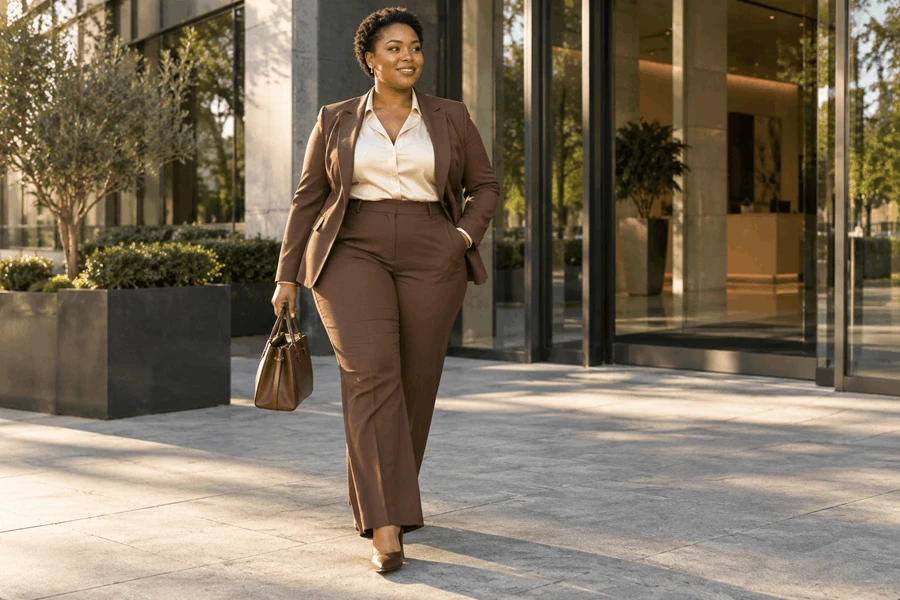
Workwear ideas that balance polish, comfort, and personality, so your attention can stay on what you came to do.
Before an important meeting, it is easy to give a jacket more responsibility than any jacket can carry. You want it to communicate competence, settle your nerves, and perhaps make the room a little more welcoming. You button it, unbutton it, and wonder whether another outfit would say the right thing more clearly. Underneath the question about clothes may be a larger wish: to arrive without having to defend your presence.
Clothing can help you feel prepared, but it does not create your qualifications. Your knowledge, judgment, effort, and experience arrive with you. A useful work wardrobe supports those things by making the physical business of the day easier. You can sit through the meeting, stand to present, travel between locations, and concentrate without constantly negotiating with a sleeve or waistband.
For Black women, advice about looking professional can carry additional baggage. You may have encountered expectations that seem to change depending on who is wearing the same style. A discussion of workwear should acknowledge that reality without suggesting the right purchase can remove bias. The practical aim is to find options that serve your role and preserve as much of your comfort and personality as possible.
Read the actual setting
Start with the requirements of your work. A classroom, a courtroom, a design studio, a shop floor, and a home office may call for different clothing. Check any applicable dress and safety rules, then think about the tasks you perform. Protective equipment, closed shoes, or restrictions around loose fabric may be part of doing the job safely rather than questions of taste.
Where the expectations are less explicit, ask for examples. “What do people usually wear for client meetings?” is a practical question, especially when beginning a new role. Look for patterns across several colleagues rather than treating one person's wardrobe as the standard. You are gathering information, not deciding that you must copy the most expensive outfit in the room.
Consider the whole day. If you commute on foot, need to carry equipment, or move between very different temperatures, the outfit has to accommodate those circumstances. A change of shoes, a light layer, or a bag that actually holds your belongings may do more for your sense of readiness than another decorative detail.
Choose a dependable starting combination
A work outfit becomes easier to assemble when you know a few combinations already function well. That might be trousers, a knit top, and a jacket; a simple dress with comfortable shoes; or a skirt with a shirt and soft layer. Choose according to your workplace and preferences. There is no universal list that makes the same sense for every woman.
Begin with the item that affects your comfort most. If trousers are difficult to fit, solve that problem before collecting more blouses. If you stand for long periods, the shoes deserve early attention. Building around the hardest-working piece can prevent an attractive outfit from failing at the point where you need it most.
Try the complete combination for more than a few seconds. Sit at a desk, reach forward, lift your arms, and carry the bag you expect to use. Notice whether the jacket pulls, the neckline shifts, or the skirt restricts your stride. You are testing a working arrangement, so movement belongs in the fitting process.
Choose underlayers for your own comfort and desired coverage. You do not need to tolerate constant adjustment because an outfit looked polished while you stood still. If the construction requires a complicated solution every time you wear it, another garment may be a better investment of your attention.
Keep the research in proportion
Researchers have studied the relationship between clothing and the wearer's thoughts and behavior under the term enclothed cognition. A meta-analysis by C. Blaine Horton, Hajo Adam, and Adam D. Galinsky (https://pubmed.ncbi.nlm.nih.gov/37458322/) found concerns about the replicability of early studies while identifying evidential value in later research. The findings do not justify promising that a particular suit will produce success.
A sensible personal experiment is narrower: notice which clothes help you feel ready for your own tasks. You may find a familiar jacket useful before a presentation because it belongs to a practiced routine. Another woman may concentrate better in a soft, unobtrusive outfit. Your observations can guide your choices without turning preferences into universal psychological laws.
It is also possible to feel nervous in clothes you love. That does not mean the outfit has failed. Important moments can remain important after you are dressed. Preparation can include reviewing your notes, arranging transport, and giving yourself enough time to arrive. The wardrobe is one part of that preparation, not the whole of it.
Let personality appear where it works for you
A professional wardrobe can contain recognizable details. Perhaps you like a deep green blouse, a patterned lining, a particular pair of earrings, or a scarf with a family connection. One or two details may be enough to make an otherwise simple combination feel personal. You can decide how much expression suits the setting and your own comfort.
Color can be subtle without disappearing. Burgundy, navy, chocolate, cream, and olive can offer different moods while remaining easy to combine. If you enjoy stronger color, try it in a familiar shape first. The garment's cut may provide enough continuity that the new shade feels like an addition to your wardrobe rather than a complete departure.
Texture is another option. A fine knit under a structured jacket creates a different impression from a crisp shirt, even in similar colors. A matte fabric may feel calmer than a shiny one; a small pattern may interest you more than a solid surface. These are visual choices you can explore without attaching moral value to any of them.
Hair and personal adornment belong to your sense of self as well. You should not have to accept the idea that natural texture is inherently less professional. Practical decisions about your workday can exist alongside that conviction. If a workplace concern involves discrimination or rights, seek appropriate guidance rather than treating a style article as legal advice.
Prepare for the ordinary inconveniences
A beautiful outfit can become frustrating because of something small: a button that loosens, a top that shows more than expected under bright light, or trousers that collect lint. Check garments before the morning you need them. The point is to reduce preventable distraction, not to chase a flawless appearance that no real day can guarantee.
Keep a modest workday kit if it helps: a spare fastening, a lint brush, or another item you actually use. Avoid building an elaborate emergency bag around imagined disasters. Experience will tell you what is useful. A spare layer at work may matter more than a dozen products you never reach for.
Plan for weather in practical terms. A coat should fit over the outfit rather than crush it. A hem should allow you to walk comfortably in the shoes you will wear outside. If you change shoes at your destination, make sure the trouser length works with both options or choose a different combination.
For video meetings, test the outfit on your own screen when the occasion matters. Lighting, framing, and patterns may look different through a camera. Keep the adjustment simple and relevant. You are preparing to communicate with people, not producing a fashion campaign from your desk.
Repeat what earns your trust
When a combination works through an entire day, record it. A photograph and a short note can remind you which shoes, layers, and accessories made it comfortable. Build a small collection of dependable options for different circumstances: routine days, presentations, travel, and events that require a little more formality.
Repetition can be a relief. You do not need to prove creativity through a different outfit every morning. A consistent wardrobe may give you more room to think about your actual work. If you enjoy variety, change a blouse or accessory within a familiar structure instead of replacing every part of the arrangement.
Pay attention when an old favorite stops working. Your role may change, your commute may become longer, or your body may need a different fit. A wardrobe is allowed to respond. Keeping clothes out of loyalty to a previous version of your work life can leave the present version unnecessarily uncomfortable.
Arrive as a person, not a presentation
There may still be mornings when you look at the mirror and feel uncertain. Choose the option that meets the practical requirements and causes the least distraction. Then turn toward the part of the day you can prepare more directly: the question you want to ask, the point you need to explain, or the decision you are there to help make.
If someone compliments your outfit, enjoy it. If nobody mentions it, the clothes may be doing their job quietly. Visibility is not the only measure of a successful choice. Sometimes the best outcome is that you forget the outfit because it lets you be fully occupied with the conversation.
And when you leave the room, give yourself credit for what you contributed. Remember the clear explanation, the thoughtful question, the moment you spoke despite nerves, or the work you completed afterward. Your clothes accompanied those actions. The substance came from you, and it remains yours when the jacket is back on its hanger.
© 2026 TopBlackBeauty.com

As a passionate news reporter, I am fueled by an insatiable curiosity and an unwavering commitment to truth. With a keen eye for detail and a relentless pursuit of stories, I strive to deliver timely and accurate information that empowers and engages readers.
Comments (0)