
The Beginner’s Guide to Beautiful Locs
Before the first appointment, make space for good questions, realistic expectations, and a beginning that feels like yours. You may have saved the photograph months ago: a woman with locs falling around her face, looking entirely at ease. Something about the picture stayed with you. It might have been the shape, the movement, the confidence, or the possibility of seeing yourself differently.
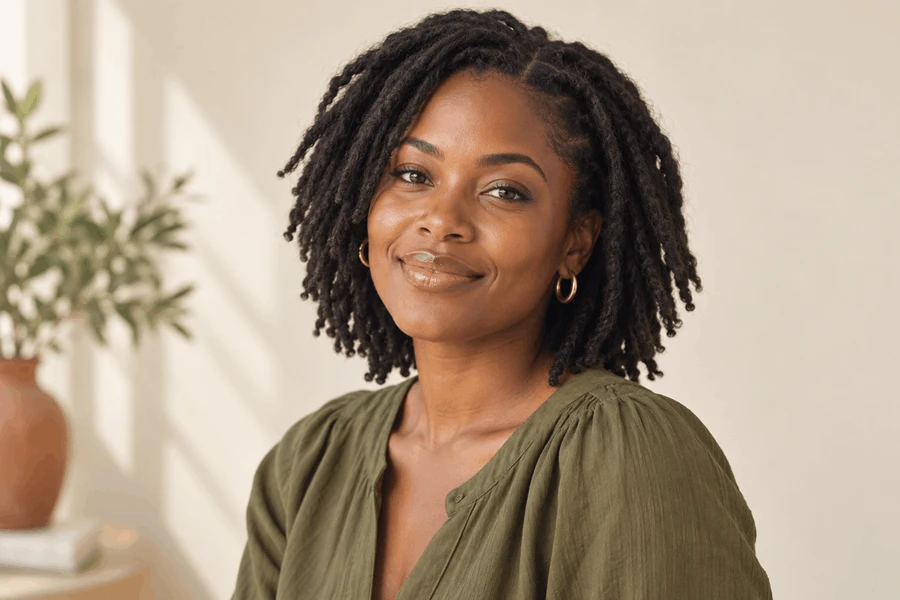
Before the first appointment, make space for good questions, realistic expectations, and a beginning that feels like yours.
You may have saved the photograph months ago: a woman with locs falling around her face, looking entirely at ease. Something about the picture stayed with you. It might have been the shape, the movement, the confidence, or the possibility of seeing yourself differently.
Now the idea is becoming a decision, and the questions are arriving. How should you start? What size should you choose? What happens at work while your hair changes? Will you recognize yourself in the mirror? There is room for excitement and uncertainty at the same time.
Beginning locs does not require a perfect origin story. Some women make the choice for cultural or spiritual reasons. Others love the appearance, want a different relationship with styling, or simply feel ready to try something new. You do not have to borrow someone else's explanation to make your own choice meaningful.
What helps is information that belongs to your circumstances. Before choosing a method or booking a long appointment, give yourself time to understand the commitment you are considering.
Separate inspiration from instructions
A photograph can show an appearance, but it cannot show the full history behind it. You may not know how the locs were started, how long they have been developing, whether extensions are present, or how the look was prepared for the image. Use inspiration pictures to describe what attracts you, not to set a deadline for becoming somebody else.
Choose several photographs and identify the details you like. Is it the overall volume? The parting pattern? The size of individual locs? The length around the face? Those observations give a professional something more useful than “I want exactly this.”
Include a picture of an everyday look as well as a special occasion style. You are choosing hair that will accompany ordinary mornings, warm weather, errands, exercise, and sleep. A decision that suits those moments has a better chance of feeling comfortable after the excitement of the first appointment fades.
Book a conversation before the installation
A consultation should include your current hair, your previous chemical or color services, your scalp history, your preferred appearance, and your available maintenance time. Ask what the professional notices and which options they would consider for you. A clear explanation is more useful than a confident promise that every head can follow the same plan.
An academic review of Black hair and scalp care discusses the importance of understanding both grooming practices and scalp disorders. That broader view matters here: a styling decision should take account of the person wearing it, including any existing concern. Anais Brasileiros de Dermatologia, 2015 (https://pmc.ncbi.nlm.nih.gov/articles/PMC4560533/)
If you already have unexplained thinning, tenderness, sores, or a persistent scalp problem, arrange medical assessment rather than expecting a new style to resolve it. A loctician can guide styling and maintenance within their expertise; a dermatologist can evaluate disease. You may benefit from both, with each doing the work they are qualified to do.
Understand the starting options in plain language
You may hear about comb coils, two-strand twists, braids, interlocking, freeform approaches, or methods marketed under a particular system. Rather than choosing by popularity alone, ask how the proposed method works with your current length, texture, desired size, and care preferences. Ask to see examples of the professional's own work at different stages.
The details matter more than a label. What maintenance is expected? Who will perform it? What training does the practitioner have? Can another qualified professional maintain the result if you move or the original practitioner becomes unavailable? A method should come with understandable information, not a sense that you are entering a secret process.
There is no universal timetable for when every set of locs will look or feel mature. Starting method, hair characteristics, and care all affect the experience. Be cautious of exact promises based only on a photograph or a brief online message. An honest consultation leaves room for individual variation.
Talk about size before you talk about drama
Very small locs, medium locs, and larger locs create different visual possibilities and may involve different maintenance commitments. Ask how the proposed size relates to your density, your preferred styles, and the time you can realistically spend on appointments. The smallest option is not automatically the most versatile choice for your life.
Discuss the parting arrangement too. You may want flexibility in how you wear your hair, but your preferences should be considered alongside the condition and distribution of your hair. A professional should be willing to explain the choices without making you feel embarrassed for not knowing the vocabulary.
If the recommendation surprises you, ask why. You are allowed to think before agreeing. A thoughtful practitioner does not need you to make a rushed decision simply because a slot has opened in the calendar. This is your head, your money, and your daily experience.
Ask for a written care plan
Before leaving the first appointment, know how you are expected to cleanse, dry, and handle your new locs. Ask for product guidance that includes purpose and instructions, not only brand names. If you swim, exercise frequently, wear a work helmet, or cover your hair for religious reasons, explain that before the plan is finalized.
Do not assume that beginning locs means abandoning scalp cleanliness. If instructions seem to require ignoring significant discomfort or postponing care despite a problem, ask for clarification or another professional opinion. Your scalp remains living skin throughout the process.
Keep the instructions somewhere easy to find. A short note on your phone can hold the suggested routine, the next appointment, and the questions that arise afterward. You should not have to remember every detail while you are also taking in your new reflection and wondering whom to send the first photograph.
Make the money conversation ordinary
Ask for the full starting price and an explanation of what is included. Then ask about future maintenance, possible repairs, consultations, cancellations, and any products you are expected to purchase. An affordable first appointment can lead to a maintenance pattern that does not fit your budget; learning that early protects your choices.
Think about travel and time away from work as well as the service price. If a specialist is far from home, what happens when an appointment needs to change? Is there an appropriate local alternative? Practical questions do not make the decision less beautiful. They make it more sustainable.
You can say, “I want to understand the likely ongoing cost before I commit.” That is a reasonable request. You do not have to apologize for having a budget, and you should not have to purchase uncertainty because you are afraid of seeming difficult.
Let the early stages be visible
There may be days when your hair looks unfamiliar and you want reassurance. Try to leave room for the fact that a beginning often looks like a beginning. You are not obligated to photograph every change, but occasional pictures in similar lighting can help you notice development without examining yourself constantly.
You may hear comments from people who preferred your previous style. Decide in advance how much conversation you want to have. “I'm enjoying trying something new” can be enough. You do not owe a detailed defense of a personal choice to every relative, colleague, or stranger who offers an opinion.
At the same time, you do not have to love every moment to have made a worthwhile decision. Mixed feelings are allowed. You can ask questions, adjust your plans, or reconsider. Confidence does not require pretending that the experience contains no inconvenience.
Protect comfort as the look develops
A clinical review of traction alopecia explains that repeated pulling can injure hair follicles and, when prolonged, may lead to permanent loss. Locs are not exempt from that concern when styling or maintenance creates excessive tension. Billero and Miteva, 2018 (https://pmc.ncbi.nlm.nih.gov/articles/PMC5896661/)
Discuss comfort during maintenance, especially around areas you already know are sensitive. A neat finish should not require you to quietly endure pain. If something hurts, speak up while the professional can assess and change what is happening, rather than waiting until you are home.
Choose adornments and gathered styles with the same attention to how they feel. The goal is to enjoy your hair throughout the day, not only during the few seconds when a photograph is taken. Beautiful work should leave space for the person living inside it.
Build a relationship that allows questions
Notice how your practitioner responds when you ask for an explanation. Do they listen? Do they distinguish what they know from what they cannot promise? Are their hygiene practices and booking policies clear? Skill matters, and so does your ability to communicate without feeling small.
Bring observations to follow-up appointments rather than trying to diagnose every change yourself. Describe where something feels different, when you noticed it, and what you have been doing. Specific information makes a better conversation than comparing your entire journey with a stranger's timeline.
Over time, you may find that your original inspiration becomes less important. You begin to know the way your own locs sit, the styles you reach for, the details that make you smile. The saved photograph can remain beautiful without remaining the destination.
Your beginning does not need to impress anyone. It needs to be informed, comfortable, and yours. There is pleasure in choosing with care, asking the questions that matter, and allowing your reflection to become familiar at its own pace. The story is not waiting for some future length before it can belong to you. It has already started.
© 2026 TopBlackBeauty.com

As a passionate news reporter, I am fueled by an insatiable curiosity and an unwavering commitment to truth. With a keen eye for detail and a relentless pursuit of stories, I strive to deliver timely and accurate information that empowers and engages readers.
Comments (0)