
Our Hair Has Always Told a Story
A celebration of expression, memory, and the freedom to decide what your own appearance means. Before a hairstyle becomes a photograph, it is often a room. A kitchen chair moved toward the light. A salon with overlapping conversations. A bathroom mirror clouded by steam. A friend standing behind you, deciding whether the part is straight enough. These places can hold as much memory as the finished style.
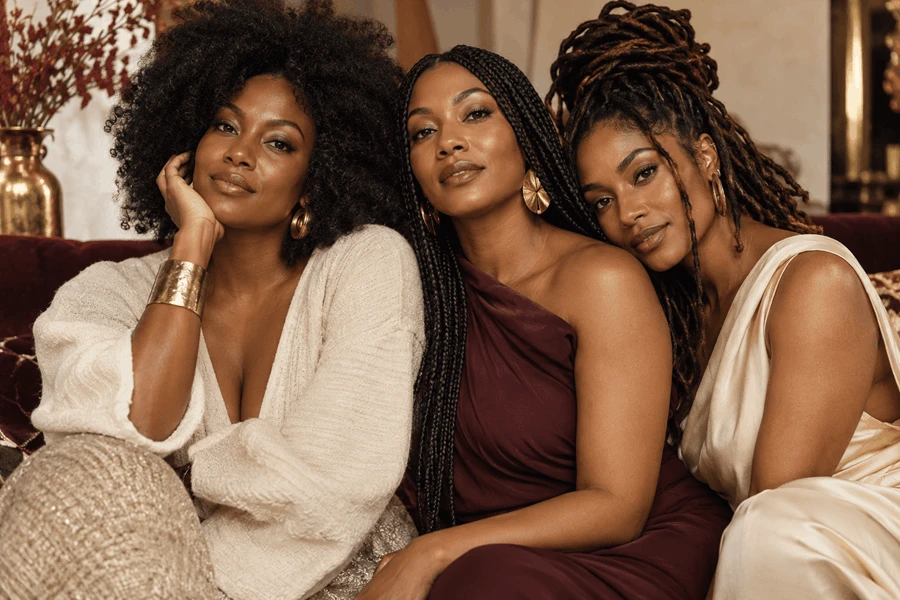
A celebration of expression, memory, and the freedom to decide what your own appearance means.
Before a hairstyle becomes a photograph, it is often a room. A kitchen chair moved toward the light. A salon with overlapping conversations. A bathroom mirror clouded by steam. A friend standing behind you, deciding whether the part is straight enough. These places can hold as much memory as the finished style.
You may remember the sound of a comb placed on a counter or the relief of reaching the final section. You may remember the first time you chose a look without asking whether anyone else would approve. Hair can carry affection, impatience, experimentation, pride, and the plain practical question of what will work before you leave for the day.
For Black women, those private experiences exist alongside public meanings that are not always of our choosing. Other people may read a hairstyle as a statement before asking whether its wearer intended one. A celebration of Black hair should leave room for history and also for the ordinary freedom to like what you like.
The story is larger than a single style
There is no hairstyle capable of representing every Black woman. Texture, region, age, faith, work, personal taste, and family history shape different relationships with hair. Even one woman may move through several looks without feeling that she has changed her deepest commitments.
Jasmine Nichole Cobb’s scholarly book New Growth examines Afro-textured hair through historical and visual materials, including photography, film, and art. Her work treats hair as something seen and felt, connected to wider questions of Black life and public space. Jasmine Nichole Cobb, Duke University Press, 2022 (https://www.dukeupress.edu/new-growth)
That perspective encourages a richer conversation than deciding which look is most authentic. We can ask what a style makes possible, what experiences surround it, and how its meaning changes across settings. The answer may be political, intimate, practical, playful, or several of those at once.
Remember the hands without romanticizing every memory
For some women, childhood hair care recalls closeness: sitting near a parent, hearing family conversation, feeling cared for before a special occasion. For others, it recalls discomfort, criticism, or the sense that their natural texture needed to be corrected before they could be seen.
Both kinds of memory deserve room. You do not have to turn a painful experience into nostalgia because it involved someone you love. Nor do you have to dismiss the affection in a memory because the methods might be different today. A relationship can contain care and choices you no longer wish to repeat.
When telling these stories, pay attention to the conditions around them. Was the caregiver tired, working with limited time, or following the only techniques she knew? Context can deepen understanding without requiring you to deny what the experience felt like. It can also help you choose a more comfortable ritual for the next generation.
The salon as a place of exchange
A salon visit can involve much more than a service. People exchange recommendations, discuss family news, disagree about music, and recognize changes in one another’s lives. For a regular client, the appointment may become a familiar marker in a month full of other obligations.
Still, no salon is the same as every other salon. Some are lively; some are quiet. Some clients seek conversation; others want a peaceful hour. The value lies partly in finding a space where your preferences can be stated without embarrassment.
Consider the expertise involved as well as the atmosphere. Styling requires decisions about shape, proportion, technique, and the needs of an individual client. Admiring the result should include respect for the labor that produced it. Clear booking expectations, fair payment, and credit when sharing work are practical ways to show that respect.
A photograph can preserve a turning point
An old picture may remind you of a haircut more vividly than any date on a calendar. You remember who you were living with, what music you liked, or how you felt walking into a room. The hairstyle becomes attached to a period of life without necessarily defining everything about it.
Try looking at a series of your own photographs without ranking the versions of yourself. What were you experimenting with? What did you enjoy? Which decisions were yours, and which were shaped by expectations you no longer share? The exercise can reveal change without turning the past into a collection of mistakes.
You may feel tenderness toward a younger self who was trying very hard to get it right. Let her remain visible. She did not need to know every technique or have perfect confidence to deserve a photograph in which she appears fully herself.
Public meaning does not cancel private choice
A natural style may feel connected to cultural pride. It may also be the look a woman prefers because she likes its shape. A wig may offer creative variety, convenience, privacy, or a response to hair loss. The appearance alone cannot tell you which explanation applies.
Ask before making someone’s head the subject of a lesson. Complimenting a style does not require demanding the story behind it. A woman may be happy to explain her process, or she may want to finish buying groceries without becoming a public educator.
This freedom matters within Black communities as well as outside them. We can value cultural expression without establishing a new set of rules about which women are expressing it correctly. The right to choose becomes smaller when every choice has to pass a test of belonging.
Make room for the hair you have now
Hair changes across a life, and so can a woman’s relationship with it. Length, color, density, and preferred maintenance may shift. A style that once felt easy may become inconvenient; an option you dismissed years ago may begin to feel inviting.
Cultural celebration should include older women, women with very short hair, women with hair loss, and women who cover their hair. A narrow collection of glossy, abundant styles can unintentionally suggest that only certain heads belong in the picture.
Look for beauty in a wider range of forms. Silver coils, a close cut, a wrapped style, a carefully chosen wig, and a familiar set of locs can each carry someone’s taste and experience. Appreciation becomes more generous when it does not make volume or length the price of being seen.
Tell the story of creativity accurately
When a style inspires you, learn what you can about the person who created the particular work you are sharing. Credit the stylist or artist when that information is available. Avoid turning another person’s skill into an anonymous image collected for your own attention.
Be precise about what you know. An intricate look does not need an invented ancient origin to deserve admiration. If a historical claim appears online without reliable evidence, you can appreciate the style while leaving the claim unrepeated. Wonder is not weakened by accuracy.
The same care applies to cultural names and practices. Ask about a specific community rather than describing every influence as generically African. The diaspora contains many histories, and attention to their differences can make the conversation more interesting, not less connected.
Let younger girls hear language they can live with
The words spoken during hair care can linger. A child may remember whether the adults around her described her texture with irritation or curiosity. She may notice which relatives receive compliments and which are compared with an ideal they cannot naturally resemble.
Choose descriptions that help with the task. A section may need more time. A style may need a different method. Those practical observations do not require treating the child’s hair as a flaw. Let compliments include her ideas, patience, humor, and preferences rather than focusing only on whether the result looks neat.
Invite her participation in age-appropriate ways. Ask which accessory she likes or which comfortable style she would enjoy. The conversation can teach her that care involves listening to her body and making choices, not simply becoming an acceptable object for other people to inspect.
Enjoy the ordinary version too
Magazine images tend to capture hair at a carefully prepared moment. Real life includes the days between appointments, weather that changes a finish, and mornings when a simple option is the right one. A cultural celebration that excludes those moments can make beauty feel unusually fragile.
You are allowed to enjoy your hair without making every day a presentation. There can be affection for the elaborate look and relief in the familiar one. There can be pride without constant photography. There can be a style chosen entirely because it makes the week easier.
This is part of what makes hair culture lively: people adapt, improvise, share ideas, and return to favorites. The story continues in ordinary decisions, often without anyone announcing that an important cultural act has occurred.
Keep authorship close to the person wearing it
If you want to preserve a hair memory, describe the whole scene. Who was there? What did the room sound like? What did you hope the style would give you? A photograph with a few honest sentences can preserve more than a picture with a dramatic slogan attached.
Ask the women in your life about a hairstyle they loved and why. You may hear about romance, work, freedom, convenience, or a birthday they still remember. Let the answers differ. No one needs to produce a profound explanation for a look that simply made her happy.
Our hair can connect us to history while remaining part of an ordinary body moving through an ordinary day. It can carry memories and invite invention. It can be admired without being touched, discussed without being judged, and changed without requiring an apology. The story becomes richer when the woman wearing it remains its most important voice.
© 2026 TopBlackBeauty.com

As a passionate news reporter, I am fueled by an insatiable curiosity and an unwavering commitment to truth. With a keen eye for detail and a relentless pursuit of stories, I strive to deliver timely and accurate information that empowers and engages readers.
Comments (0)