
More Than a Recipe: A Taste of Home
The meals we remember carry people, places, and the quiet knowledge of the hands that made them. The instruction may sound unhelpfully simple: add enough, stir until it looks right, taste it again. You want a measurement. The person beside you wants you to notice the pot. Between those two approaches lies a kind of knowledge that can be difficult to put on paper and very easy to miss if you are in a hurry.
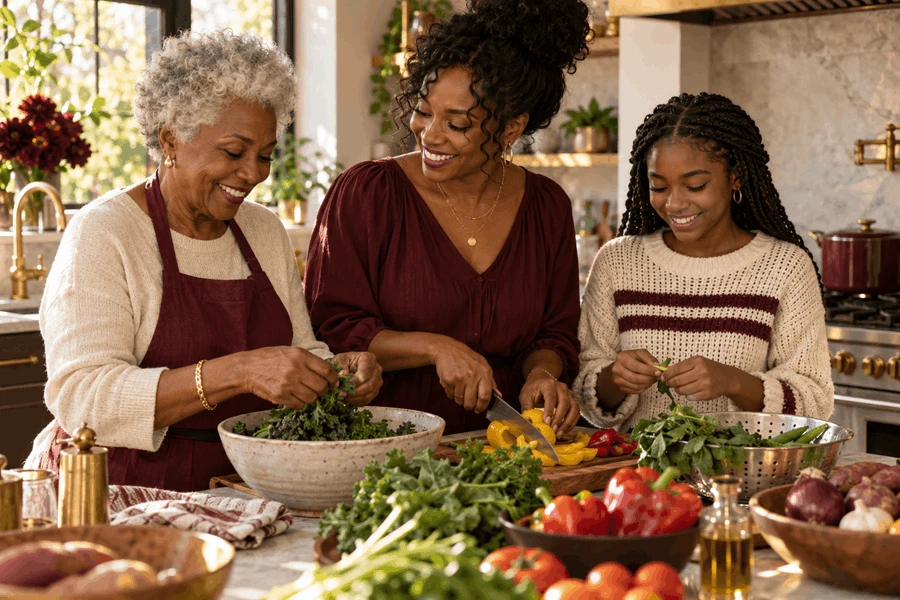
The meals we remember carry people, places, and the quiet knowledge of the hands that made them.
The instruction may sound unhelpfully simple: add enough, stir until it looks right, taste it again. You want a measurement. The person beside you wants you to notice the pot. Between those two approaches lies a kind of knowledge that can be difficult to put on paper and very easy to miss if you are in a hurry.
A family recipe can hold more than ingredients. It may carry the habits of a particular cook, the limitations of a particular kitchen, the memory of a place someone left, or the taste a child came to associate with being expected home. That does not make every meal sentimental. Sometimes dinner was simply what could be managed after a long day.
Both versions belong in the story. The celebratory dish and the ordinary supper can tell us something about how people lived. Preserving food traditions becomes richer when we ask about the circumstances around the recipe as well as what went into the bowl.
Begin with the dish you actually miss
You do not have to start with the most impressive meal in the family. Choose something you remember wanting to eat: a breakfast, a soup, a side dish, a snack prepared for visitors. The emotional importance of food does not always match the amount of work involved.
Ask who made it and when. Was it reserved for a holiday, or did it appear whenever a certain ingredient was available? Did one person prepare it differently from everyone else? The answers can reveal a small history of preference, resourcefulness, and adaptation.
If the cook is available and willing, ask to make it together. Watching can show you details that a spoken description leaves out. Notice the size of the pot, the order of the steps, and what the cook looks for before moving on. You are learning a practice, not merely collecting a list.
Write down the knowledge hidden inside “a little”
Experienced cooks may judge by sight, sound, smell, and texture. Rather than treating that expertise as an obstacle, ask them to explain what they notice. What changes when the mixture is ready? How do they know whether it needs more liquid? Which part of the process is easiest to rush?
Measure alongside them if they agree, then check whether the written version produces something recognizable. A recipe may need another attempt before the instructions make sense to someone who did not grow up watching the method. Treat the testing as part of the conversation rather than evidence that the cook explained badly.
Include the small warnings that rarely reach a formal recipe: which step needs attention, what can be prepared earlier, and what mistake the cook made when learning. These details make the record more useful and preserve a little of the teaching voice that gave it life.
Food traditions also tell a story about access
A family’s menu is shaped by more than taste. Availability, cost, transport, work schedules, and the places people can shop influence what reaches the table. Remembering that context can keep nostalgia from turning hardship into an attractive decoration.
Anthropologist Ashanté M. Reese’s Black Food Geographies uses ethnographic research in Washington, D.C.’s Deanwood neighborhood to examine unequal food access and residents’ responses to it. Her work connects everyday food practices with wider structures while taking community members’ knowledge and agency seriously. Ashanté M. Reese, University of North Carolina Press, 2019 (https://www.jstor.org/stable/10.5149/9781469651521_reese)
For a family conversation, this suggests questions beyond what someone cooked. Where did she shop? What was difficult to find? Who shared ingredients? Which substitutions became favorites? A recipe can reveal resourcefulness without making the conditions that required it disappear.
Name the place without flattening the people
Black food traditions contain many distinct histories. A dish associated with one island, region, country, or community may have several local versions and many family variations. Calling everything the same can erase precisely the details that make it interesting.
Ask how the cook names the dish and where she learned it. Preserve the original name when possible, alongside an explanation for readers who may not know it. If you are unsure about an origin claim, mark it as a family recollection rather than presenting it as settled history.
You can appreciate connections without insisting on sameness. Two households may use a similar ingredient in very different ways. The conversation becomes more generous when difference is an invitation to learn rather than a contest over whose version is the only real one.
Let migration and change remain in the recipe
A person who moves may adapt a dish to a new kitchen, a different ingredient, or a schedule that no longer resembles life at home. Those changes do not automatically make the result less meaningful. They may become part of how home is carried into a new place.
Ask about the first time the dish was made after a move. Was something missing? Did a friend help find an ingredient? Did the cook eventually prefer the adaptation? The answer can preserve a history of adjustment that a polished recipe title would never reveal.
You can record more than one version. An older method and a newer variation can sit beside each other, each clearly attributed. A family cookbook does not have to choose a winner before it can be useful. It can show how people continued to care for one another under changing circumstances.
Remember the work behind the welcome
The meal that felt effortless to guests may have required planning, shopping, preparation, serving, and cleanup by someone who rarely sat down. When remembering a beloved table, remember the labor that made it possible.
Ask the cook which parts she enjoyed and which she would gladly have shared. Do not assume that being good at feeding people means wanting to do all of it alone forever. A tradition becomes more sustainable when the pleasure and responsibility are distributed more fairly.
The next gathering can honor a familiar dish while changing the work around it. Someone else can shop, prepare a component, wash dishes, or organize leftovers. Appreciation becomes more convincing when the person who created the meal is also able to enjoy the company.
Make room for changing needs at the table
A family’s food needs can change over time. Allergies, medical advice, ethical preferences, budget, and personal taste may affect what someone can or wants to eat. Treat those needs as part of hosting rather than a challenge to the family’s identity.
Ask in advance when you can, and make the ingredients clear. Avoid pressuring someone to taste a food after she has declined it. A dish can remain beloved even when not every person at the table eats it.
If a traditional preparation needs adapting, work from reliable cooking guidance and any relevant professional advice. You do not have to turn the meal into a debate about whether change is allowed. Hospitality can preserve the warmth of a tradition while making practical room for the people who are present now.
Keep the story beside the instructions
A family recipe collection becomes more personal when each entry includes a short account of its place in someone’s life. Who taught the cook? When was it served? What did people call it? Which relative always requested it?
A few specific sentences are often more vivid than a grand claim about heritage. “She made this when her sister visited” can carry a recognizable relationship. “He always asked for the corner piece” preserves a person in a way that a general tribute may not.
Include photographs if the people involved agree. The hands preparing the food, the serving dish, or the handwritten card can be as meaningful as a perfect image of the finished plate. An archive of family food should have room for use and wear, not only presentation.
When the person is no longer here
Sometimes the recipe becomes important only after the cook is gone. You may have a few ingredients, a remembered taste, or an old message that suddenly feels precious. Trying to recreate the dish can bring pleasure and grief into the same afternoon.
Ask others what they remember, but allow the reconstruction to remain uncertain. Label it honestly as an approximation if that is what it is. A dish does not need to match perfectly to become a meaningful act of remembrance.
You may decide to keep experimenting, or you may find another way to remember the person. There is no obligation to recover an exact flavor as proof of love. The relationship was larger than a recipe, and the missing measurement is not a failure of devotion.
Let the next cook leave her own mark
When a younger relative wants to learn, give her a real role in the process. Explain what you are doing and let her practice an appropriate step. If she asks why, treat the question as interest rather than disrespect for a method that feels obvious to you.
She may eventually alter the dish. Ask what she was trying to achieve before deciding that the change has ruined something. You can preserve the earlier version and still be curious about the new one. Tradition can contain memory and invention without losing its connection to people.
The most enduring gift may be the confidence to cook for herself and others, to ask questions, and to recognize that knowledge can be shared without humiliation. That kind of teaching can outlast a particular ingredient or utensil.
When the food is ready, let the cook sit down. Pass the bowl, ask the question you have been meaning to ask, and allow the conversation to wander. Home can be a place, but it can also be an experience people make for one another: being expected, being considered, having enough room at the table. A recipe gives that experience a form you can practice. The taste is part of what you carry. So is the way you offer it.
© 2026 TopBlackBeauty.com

As a passionate news reporter, I am fueled by an insatiable curiosity and an unwavering commitment to truth. With a keen eye for detail and a relentless pursuit of stories, I strive to deliver timely and accurate information that empowers and engages readers.
Comments (0)